
[Context: The Beast of Gevaudan is a purported beast that reportedly attacked people in the region of Gevaudan in France in 1764 before being shot and killed in September of 1765. Many called the creature a wolf but others thought it to be a hyena. Whatever the case, the story became very influential in Werewolf lore.]
The following are engravings and printed images from the 1760’s, followed by a book excerpt of Chapter two of “The Queen’s Cadet and Other Tales (1874)” by James Grant which tells the story of the Gevaudan beast and cites publications from the time.
[1764] The Beast of Gévaudan
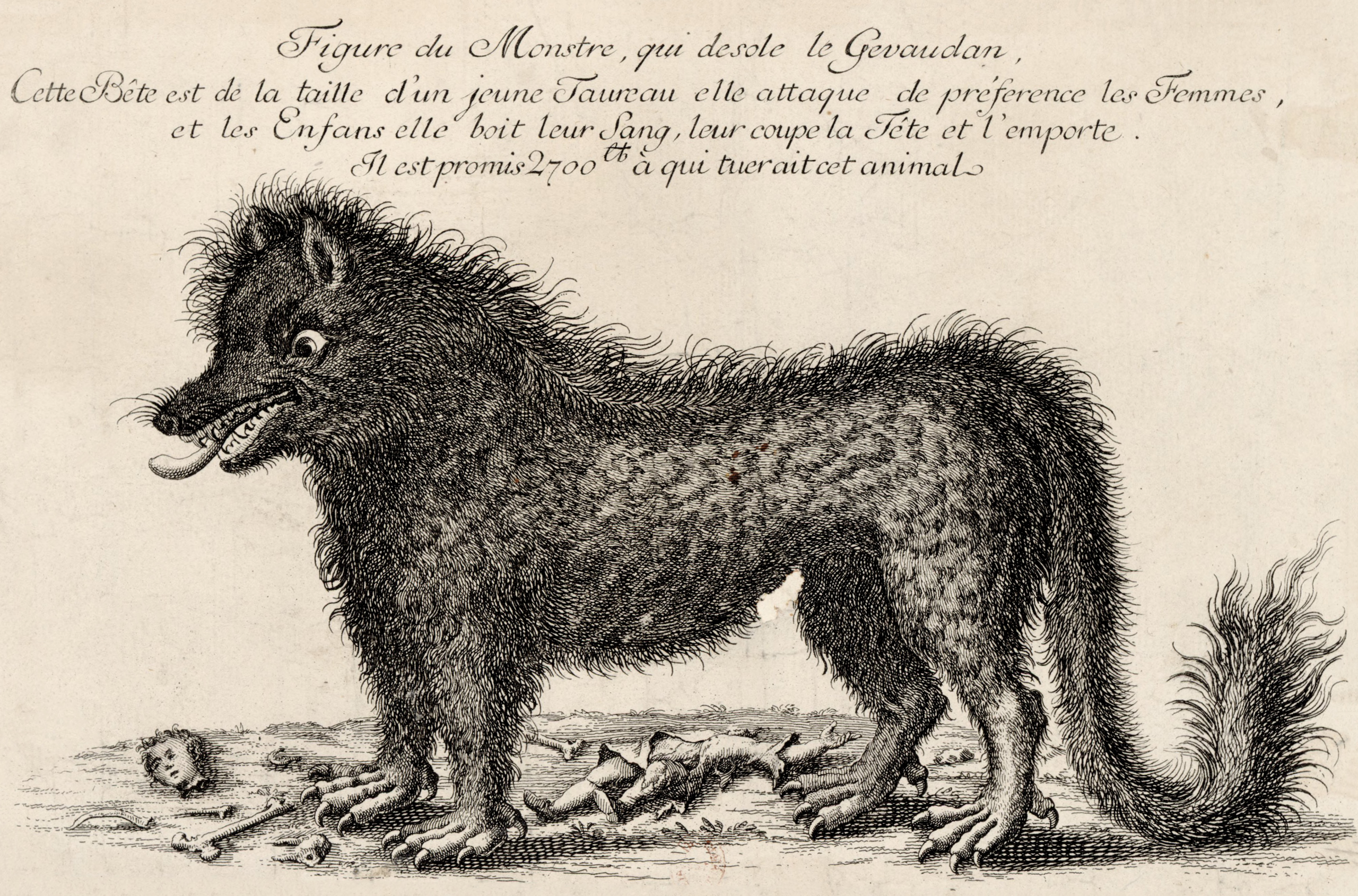
French Text: Figure du Monstre, dui desole le Gévaudan, Cette Bete est de la taille d’un jeune Taureau elle attaque de preference les Femmes, et les Enfans elle boit leur Sang, leur coupe la tete et l’emporte. ll est promis 2700 it a qui tuerait cet animal
Translated Into English: A monstrous figure that has been ravaging the Gevaudan: this Beast is the size of a young bull. It prefers to attack women and children; it drinks their blood, severs their heads, and carries them off. A reward of 2,700 is promised to whoever kills this animal.
Source(s): https://commons.wikimedia.org/wiki/File:Figure_du_monstre_qui_d%C3%A9sole_le_Gevaudan.jpg
[May 1765] Engraving from The London Magazine, Vol. XXXIV (34)
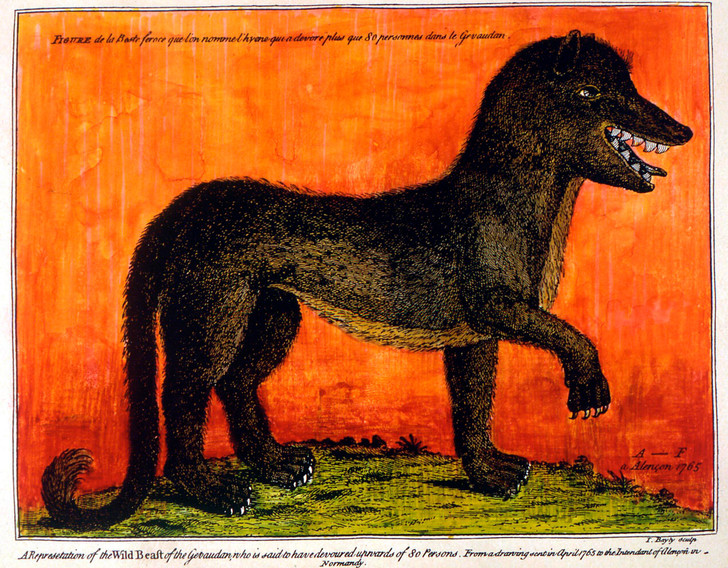
French Text: Figure de la baste feroce que l’on nommel hyane que a devore plus que 80 personnes dans le Gévaudan
Translated Into English: Depiction of the ferocious beast known as the hyena, which devoured more than 80 people in the Gevaudan.
A representation of the Wild Beast of the Gevaudan who is said to have devoured upwards of 80 Persons. From a drawing sent in April 1765 to the [illegible] of [illegible] – Normandy. (Drawn by AF – 1765) [Note: This image was later reprinted in the influential book “Werewolf (1933)” by Montague Summers.]
Source(s): https://commons.wikimedia.org/wiki/File:B%C3%AAte_du_G%C3%A9vaudan_-_The_London_Magazine.jpg
[Circa 1765] Print showing the beast of Gévaudan attacking a woman:
French Text:
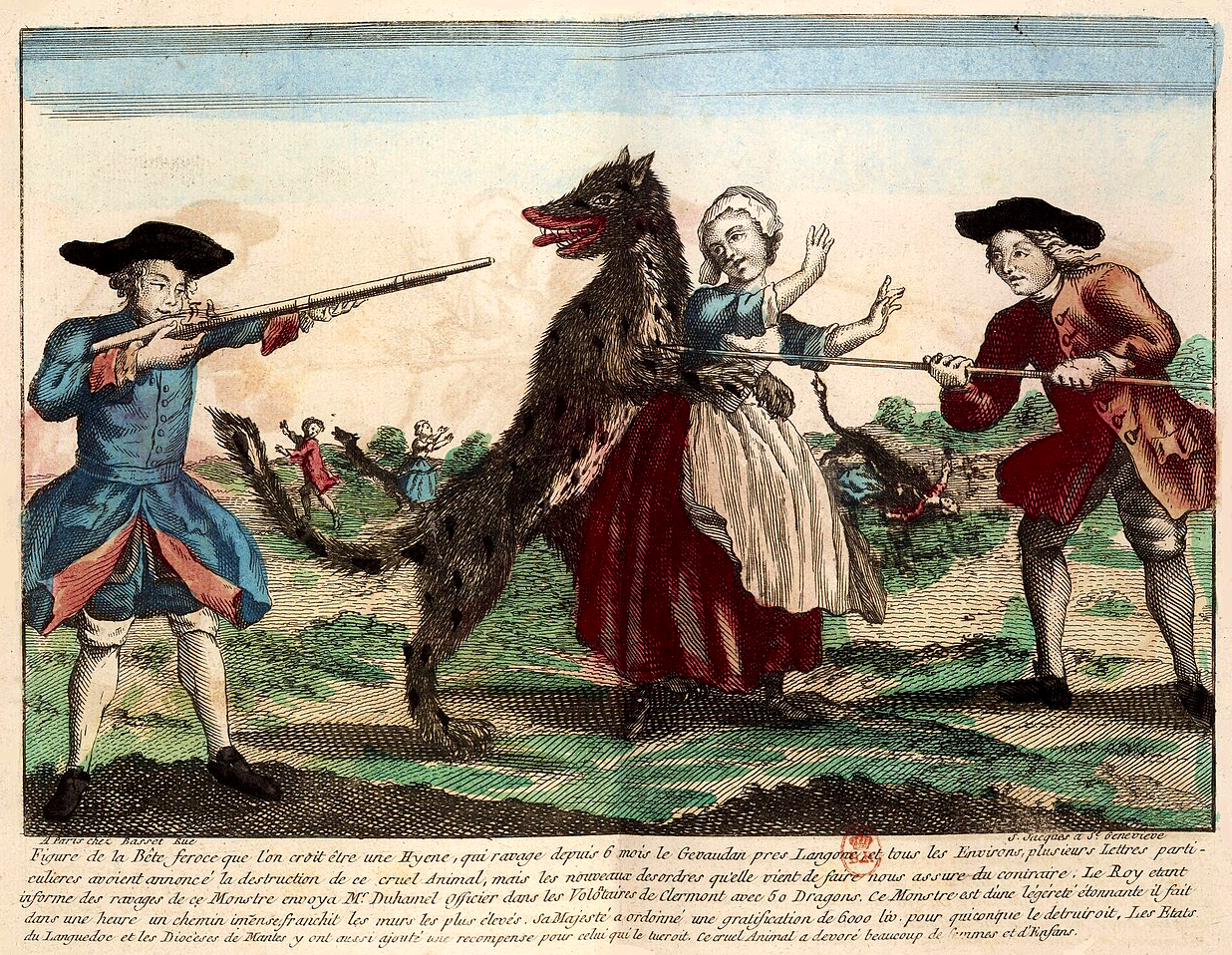
A Paris Chez Basset Sue. (S. Jacques A S. Genevieve)
Figure de la Bete feroce que l’on croit etre une hyena, qui ravage depuis 6 mois le Gévaudan pres Langone et tous les envisons, plusieurs Lettres particulieres avoient annonce la destruction de ce cruel Animal, mais les rouveaur desordres qu’elle vient de fair nouse assure du coniraire. Le Roy etant informe des ravages de ce Monstre envoya Mr Duhanel Officier dans les Volotaires de Clermont avec 5 o Dragons. Ce Monstre est gune legerete etonnante il fait fans une heure un chemin immense. franchit les murs les plus eleves. SaMajeste a ordonne une gratification de 6000 liv pour quiconque le destruiroit, Les Etats du Languedoc et les Dioceses de Mantes y ont aussi ajoutz une recompense pour celuiquile tueroit. le curel animal a devore beaucoup de lemmes et d’enfans.
Translated into English:
In Paris, at Basset’s shop. (Rue Saint-Jacques, near Sainte-Geneviève)
Depiction of the ferocious beast—believed to be a hyena—that has been ravaging the Gevaudan region (near Langogne) and its surroundings for six months. While several private letters had announced the destruction of this cruel animal, the fresh havoc it has just wreaked proves otherwise. Informed of the monster’s depredations, the King dispatched Monsieur Duhamel—an officer in the Clermont Volunteers—along with fifty dragoons[*]. The monster possesses astonishing agility, covering vast distances in a single hour and clearing even the highest walls. His Majesty has ordered a reward of 6,000 livres[**] for anyone who destroys it; the Estates of Languedoc and the Diocese of Mende have also pledged a reward for the person who kills it. The cruel animal has devoured many women and children.
[*] “Dragoon” meaning mounted infantry of the French Army, soldiers on horseback.
[**] “Livre” refers to the French currency used at the time. (Before being replaced by the Franc in 1795.)
Source(s): https://commons.wikimedia.org/wiki/File:Recueil_Magn%C3%A9_de_Marolles_-_Figure_de_la_b%C3%AAte_f%C3%A9roce.jpg
[Circa 1765] Print depicting the story of the Beast of Gévaudan
French Text:
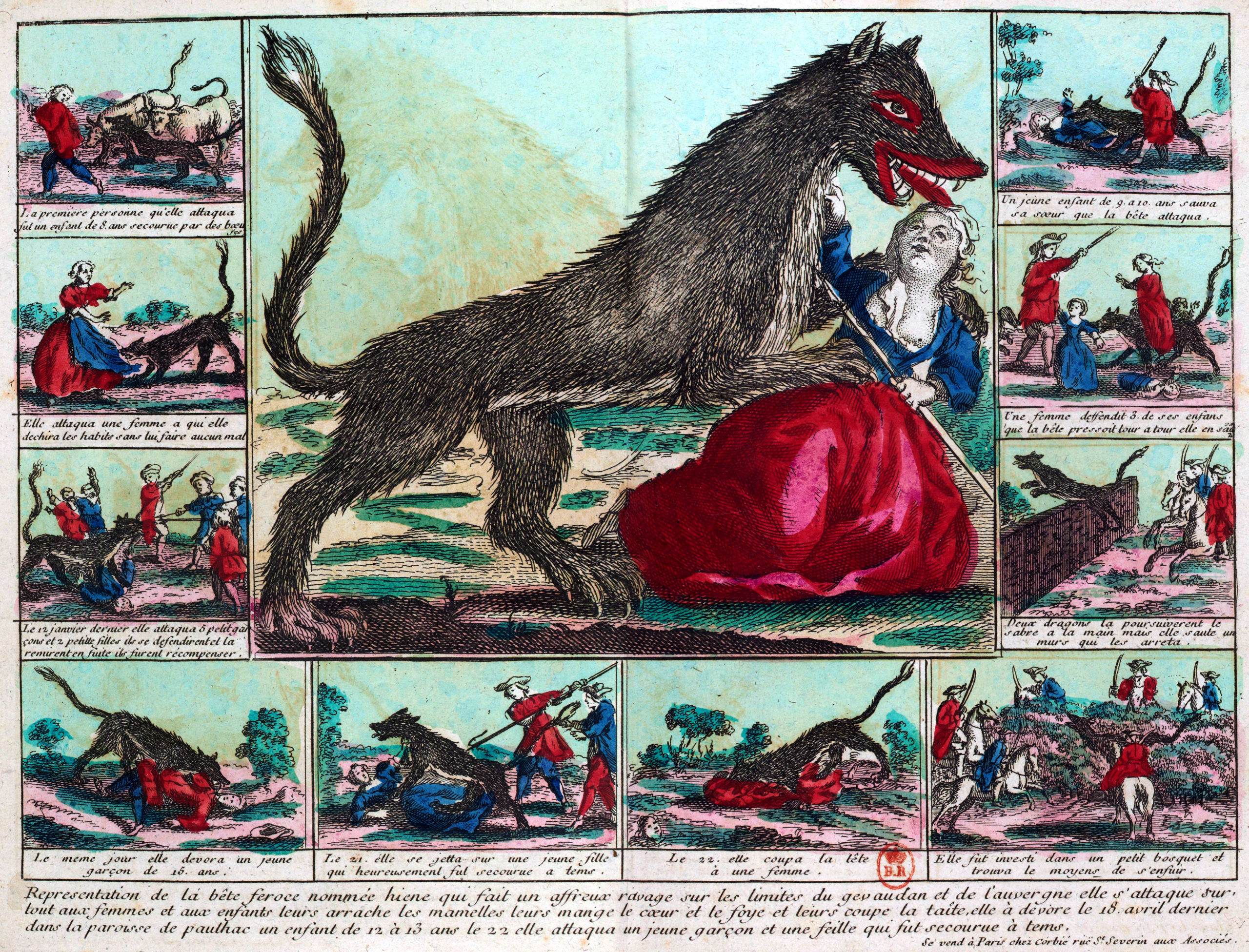
Representation de la bete feroce nommee hiene qui fait un affreux ravage sur les limites du gev audan et de Lauvergne elle s attaque sur, tout aux femmes et aux enfants leurs arrache les mamelles leurs mange le Coeur et le foye et leurs coupe la taite, elle a devore le 18. avril dernier dans la paroisse de paulhac un enfant de 12 a 13 ans le 22 elle attaque un jeune garcon et une faille qui fut secourue a tems
Se vend a Paris chez Corbie rue S. Severin aux associe’s.
(From left to right)
1. La premiere personne quelle Altaqua ful en enfant de 8 ans secourue par des beu fes
2. Un jeune enfant de 9 a 10 ans sauva sa soeur que la bete attaqua.
3. Elle altaqua une femme a qui elle dechiara les habits sans lui faire aucun mal
4. Une femme deffendit 3. de ses enfans que la bete pressoit tour a tour elle en sauva 2
5. Le 12 Janvier dermer elle altaqua 5 pelit gar cons et 2 pelitte filles its se defendirentet la remirent en fuite ils furent recompenser
6. Deux dragons la poursuiverent le sabre a la main mais elle saute un murs qui les arreta.
7. Le meme jour elle Devora un jeune garcon de 15 ans
8. Le 21 elle se jetta sur une jeune fille qui heureusement fut secourue a tems
9. Le 22. ette coupa la tete a une femme.
10. Elle fut investi dans un petit bosquet et trouva le moyens de senfuir.
Translated To English:
Depiction of the ferocious beast known as the hyena, which is wreaking terrible havoc along the borders of Gevaudan and Auvergne; it targets women and children in particular, tearing off their breasts, eating their hearts and livers, and severing their heads. On April 18th, in the parish of Paulhac, it devoured a child aged 12 or 13; on the 22nd, it attacked a young boy and a girl, who was rescued in time.
Sold in Paris by Corbie, Rue Saint-Séverin, and associates.
(From left to right)
1. The first person it attacked was an 8-year-old child, who was rescued by shepherds.
2. A young child, aged 9 or 10, saved his sister when the beast attacked her.
3. It attacked a woman, tearing her clothes but causing her no physical harm.
4. A woman defended three of her children whom the beast was harrying in turn; she saved two of them.
5. On January 12th, it attacked five young boys and two young girls; they defended themselves and drove it away, and were rewarded.
6. Two dragoons[*] pursued it, sabers in hand, but it leapt over a wall that stopped them.
7. That same day, it devoured a 15-year-old boy.
8. On the 21st, it lunged at a young girl who was fortunately rescued in time.
9. On the 22nd, it severed a woman’s head.
10. It was cornered in a small grove but managed to escape.
[*] “Dragoon” meaning mounted infantry of the French Army, soldiers on horseback.
Source(s): https://commons.wikimedia.org/wiki/File:B%C3%AAte_du_G%C3%A9vaudan.jpg
[Circa 1765] Print depicting François Antoine slaying the Beast of Gévaudan on September 21st 1765, in Chazes, Gévaudan, France:
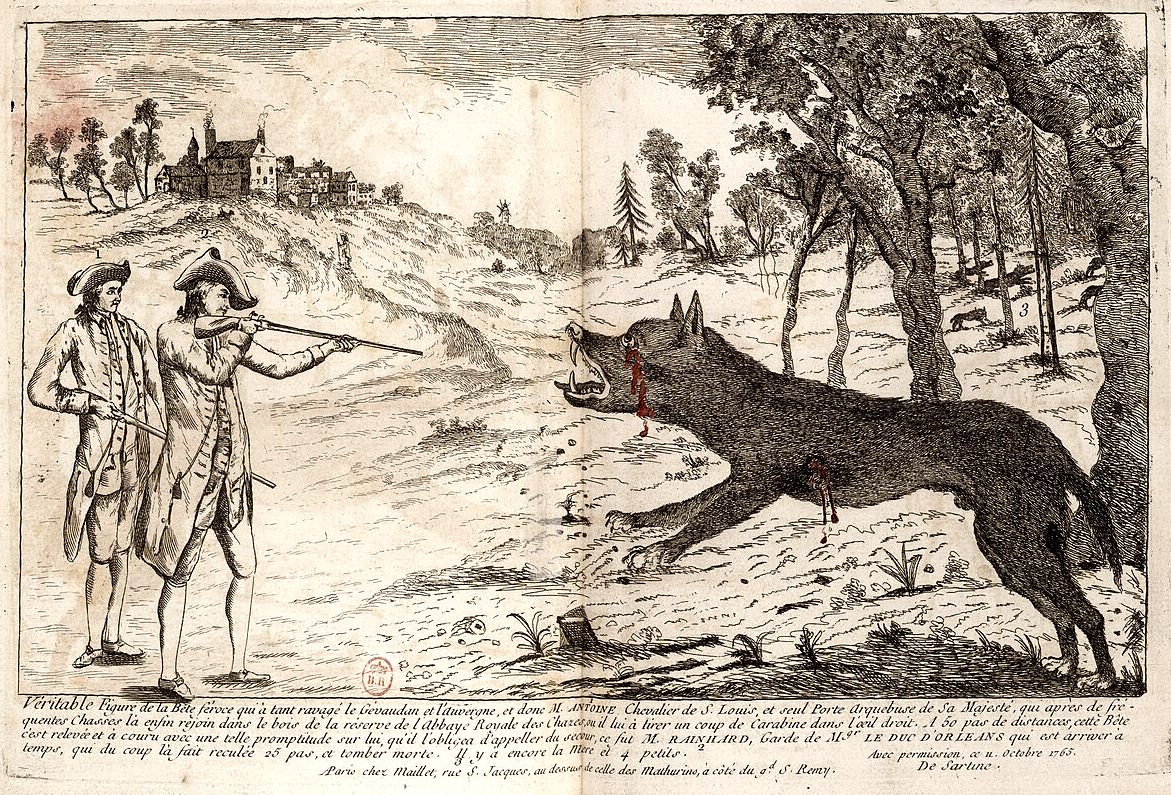
French Text:
Veritable Figure de la bete feroce qui a tant ravage le Gévaudan et l’auvergne, et done M. Antoine Chevalier de S. Louis, et seul Porte Arquebuse de sa majeste, qui apres de frequentes Chasses la enfin rejoin dans le boi de la reserve del Abbaye Royale des Chazesouil lui a tirer un coup de Carabine dans loeil droit. A 50 pas de distances, cette Bete cest relevicet a couru avec une telle promptitude sur lui, quil lobligea dappeller du secour, ce fut M. Rainhard, garde de M9 Le Duc dorleans qui est arriver a temps, qui de coup la fait reculee 25 pas, et tomber morte. ll ya encore la mere et 4 petits.
Paris chez maillet, rue S. Jacques au dessus de celle des Mathurino, a cote du gd S. Remy. Avec permission ce u. octobre 1765. De Sartune.
Translated into English:
An accurate depiction of the ferocious beast that wreaked such havoc in the Gevaudan and Auvergne regions, and which was finally brought down by Monsieur Antoine—Knight of the Order of Saint Louis and His Majesty’s sole Arquebus-bearer. After numerous hunts, he caught up with the creature in the woods of the Royal Abbey of Chazes reserve and fired a carbine shot into its right eye from a distance of fifty paces. The beast rose again and charged at him with such speed that he was forced to call for help; Monsieur Rainhard—a gamekeeper for the Duke of Orléans—arrived in time and, with a single shot, drove the animal back twenty-five paces and brought it down dead. The mother and four cubs remain at large.
Paris: Published by Maillet, Rue Saint-Jacques (above Rue des Mathurins, next to Grand Saint-Rémy). With permission, this October 1765. De Sartine.
Source(s): https://commons.wikimedia.org/wiki/File:Recueil_Magn%C3%A9_de_Marolles_-_V%C3%A9ritable_figure_de_la_b%C3%AAte_f%C3%A9roce_qui_a_tant_ravag%C3%A9_le_G%C3%A9vaudan.jpg
[Circa 1765] Wolf of Chazes, shot by M. François Antoine de Beauterne, displayed at the court of Louis XV
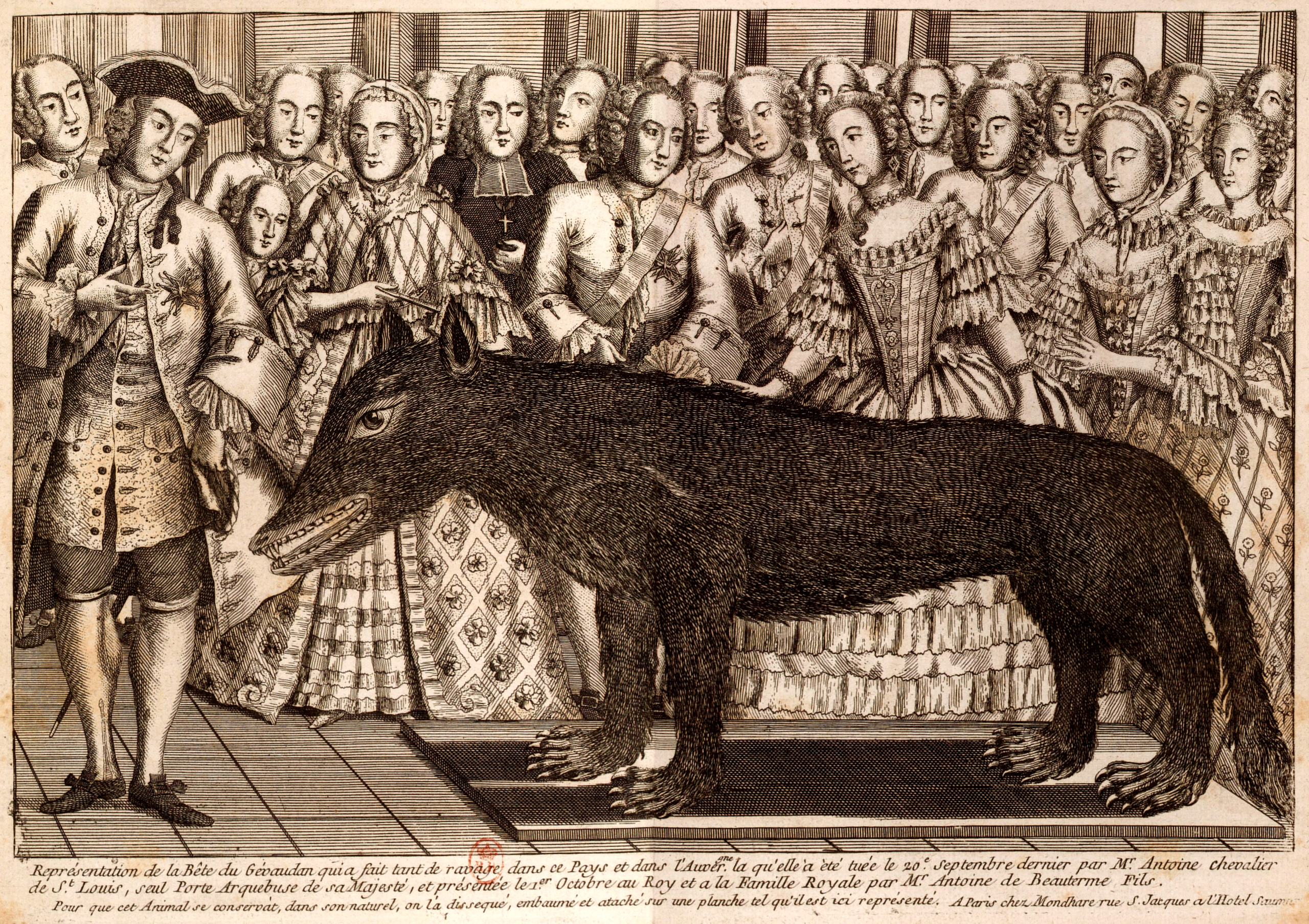
French Text:
Representation de la Bete du Gévaudan quia fait tant de ravage dans ce pays et dans l’Auvergne, la que’lle ‘a ete tuee le 20 e septembre dernier par M. Antoine chevalier de S.t Louis, seul Porte Arquebuse de sa Majeste, et presentee le 1er Octobre au Roy et a la Famille Royale par Mr. Antoine de Beauterme Fils. Pour que cet Animal se sonseroat, dans son naturel, on l’a disseque, embaume et attache sur une planche tel qu’ilest ici represente. À Paris chez Mondhare rue S. Jacques al’Hotel Saumrer
Translated Into English:
Depiction of the Beast of Gevaudan, which wreaked such havoc in that region and in Auvergne; it was killed on the 20th of last September by M. Antoine, Knight of Saint Louis and His Majesty’s sole Arquebus-Bearer, and presented to the King and the Royal Family on October 1st by M. Antoine de Beauterne the Younger. To preserve the animal in its natural state, it was dissected, embalmed, and mounted on a board, just as it is depicted here. In Paris, at Mondhare’s, Rue Saint-Jacques, Hôtel Saumrer.
Source(s): https://commons.wikimedia.org/wiki/File:Wolf_of_Chazes.jpg
[Circa 1765] The Beast of Gévaudan Depicted Instead As Man-Like
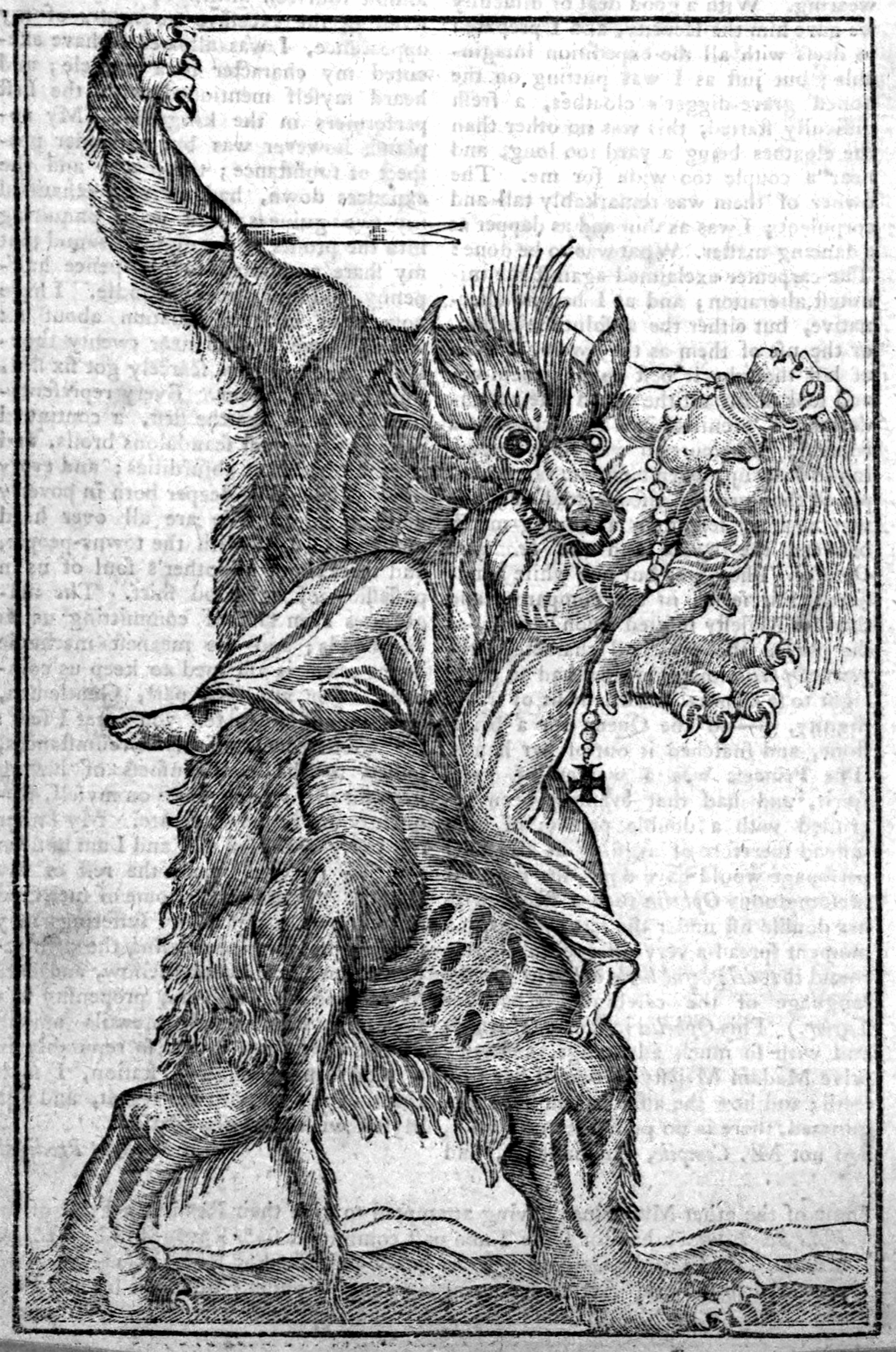
Caption: “An exact Representation of the WILD BEAST now in France, in the Act of devouring a young Woman.” [Note: this man-like or humanoid look was not how the beast was originally described.]
Source(s): https://commons.wikimedia.org/wiki/File:Loup_garou.jpg
Book Excerpt:
The Queen’s Cadet and Other Tales (1874) by James Grant
CHAPTER II – THE WILD BEAST OF GEVAUDAN.
In the year 1765, the French, Dutch, and Brussels papers teemed with marvellous accounts of a monstrous creature, called “The Wild Beast of Gévaudan,” whose ravages for a time spread terror and even despair among the peasantry of Provence and Languedoc, especially in those districts of the ancient Narbonne Gaul which were mountainous, woody, and cold, and where communication was rendered difficult by the want of good roads and navigable rivers.
In the April of that year a drawing of this animal was sent to the Intendant of Alençon, entitled “Figure de la beste (sic) feroce l’ou nomme l’hyene qui a devoré plus que 80 personnes dans le Gévaudan.” An engraving of this is now before us, and certainly its circulation must have added to the confusion of the nature of the original. This print represents the beast with a huge head, large eyes, a long tongue, a double row of sharp fangs, small and erect ears like those of a cat, the paws and body of a lion, with the tail of a cow, which trails on the ground with a bushy tuft at the end.*
* The History of France records that there appeared a wild beast in the Forest of Fontainebleau in 1653, which devoured one hundred and forty persons, before it was killed by twelve mousquetaires of the Royal Guards!
In December, 1764, it first made its appearance at St. Flour, in Provence, and on the 20th it devoured a little girl who was herding cattle near Mende. A detachment of light dragoons, sent in search of it, hunted in vain for six weeks the wild and mountainous parts of Languedoc. Though a thousand crowns were offered by the province of Mende to any person who would slay it, and public prayers were put up in all the churches for deliverance from this singular scourge, which soon became so great a terror to those districts, as ever the dragon was of which we read in the “Seven Champions of Christendom.”
No two accounts tallied as to the appearance of this animal, and some of these, doubtless the offspring of the terror and superstition of the peasantry, added greatly to the dread it inspired. French hyperbole was not wanting, and the gazettes were filled with the most singular exaggerations and gasconades.
The groves of olive and mulberry trees, and the vineyards, were neglected, the wood-cutters abandoned the forests, and hence fuel became provokingly dear, even in Paris.
In the month of January we are told that it devoured a great many persons, chiefly children and young girls. It was said by those who escaped to be larger than a wolf, but that previous to springing on its victim, by crouching on the ground, it seemed no longer than a fox. “At the distance of one or two fathoms it rises on its hind legs, and leaps upon its prey, which it seizes by the neck or throat, but is afraid of horned cattle, from which it runs away.”
It was alleged by some to be the cub of a tiger and lioness; by others, of a panther and hyena, which had escaped from a private menagerie belonging to Victor Amadeus, duke of Savoy. A peasant of Marvejols, who wounded it by a musket shot, found a handful of its hair, “which stank very much;” he averred it to “be the bigness of a year-old calf, the head a foot in length, the chest large as that of a horse, his howling in the night resembled the braying of an ass.” According to collated statements, the beast was seen within the same hour at different places, in one instance twenty-four miles apart; hence many persons naturally maintained that there were two.
On the 27th December, 1764, a young woman, in her nineteenth year, was torn to pieces by it at Bounesal, near Mende. Next day it appeared in the wood of St. Martin de Born, and was about to spring upon a girl of twelve years, when her father rushed to her protection. The woodman, a bold and hardy fellow, rendered desperate by the danger of his child, kept it at bay for a quarter of an hour, “the beast all the while endeavouring to fly at the girl, and they would both inevitably have become its prey if some horned cattle which the father kept in the wood had not fortunately come up, on which the beast was terrified and ran away.”
This account was attested on oath by the woodman, before the mayor and other civil authorities of Mende, an episcopal city in Languedoc.
On the 9th of January an entire troop of the 10th Light Horse (the Volontaires Etrangers de Clermont-Prince), then stationed at St. Chely, was despatched under Captain Duhamel in quest of the animal, which had just torn and disembowelled a man midway between their quarters and La Garge. On this occasion the Bishop of Mende said a solemn mass, and the consecrated Host was elevated in the cathedral, which was thronged by the devout for the entire day; but the beast still defied all efforts for his capture or destruction, and soon after, “in the wood of St. Colme, four leagues from Rhodez, it devoured a shepherdess of eighteen years of age, celebrated for her beauty.”
The English papers began to treat the affair of “the wild beast” as a jest or allegory invented by the Jesuits to render the Protestants odious and absurd, as it was said to have escaped from the Duke of Savoy’s collection; and “this circumstance is designed,” says one journal, “to point out the Protestants who are supposed to derive their principles from the ancient Waldensee, who inhabited the valleys of Piedmont, and were the earliest promoters of the Reformation.”
A writer in a Scottish newspaper of the period goes still farther, and announces his firm belief that this tormentor of the Gévaudanois was nothing more or less than the wild beast prophesied in the Apocalypse of St. John, whereon the scarlet lady was mounted. Another asserts that it was typical of the whole Romish clergy, and that its voracious appetite answered to another part of Scripture, “conceived in the words eating up my people as they eat bread,”—his favourite food being generally little boys and girls of Protestant parentage.*
* Edinburgh Advertiser, 1764.
After a long and fruitless chase, Captain Duhamel, before returning to quarters at St. Chely, resolved to make a vigorous attempt to destroy this mysterious scourge of Languedoc; but his extreme ardour caused his plans to miscarry.
Posting his volontaires, some on horseback, and some on foot, at all the avenues of a wood to which it had been traced, it was soon roused from its lair by the explosion of pistols and sound of trumpets. There was a cry raised of “Voilà! Gardez la-Bête!” and Duhamel, an officer of great courage, who had dismounted, rushed forward to assail it sword in hand, but had the mortification to see it, with a terrible roar, spring past the very place he had just quitted.
Two of his dragoons fired their pistols, but both missed. They then pursued it on the spur for nearly a league, and though seldom more than four or five paces from it, they were unable to cut it down, and ultimately it escaped, by leaping a high stone wall which their horses were unable to surmount; and after crossing a marsh which lay on the other side, it leisurely retired to a wild forest beyond.
The baffled dragoons reported that it “was as big as the largest park dog, very shaggy, of a brown colour, a yellow belly, a very large head, and had two very long tusks, ears short and erect, and a branched tail, which it sets up very much when running.” Fear had no share in this strange description, for the officers of Clermont’s regiment asserted that the two dragoons were as brave men as any in the corps; but some declared that it was a bear, and others a wild boar!
On the 12th of January it attacked seven children (five boys and two girls) who were at play near the Mountain of Marguerite. It tore the entire cheek off one boy, and gobbled it up before him; but the other four, led by a boy named Portefaix, having stakes shod with iron, drove the beast into a marsh, where it sunk up to the belly, and then disappeared. That night a boy’s body was found half devoured in the neighbourhood of St. Marcel; on the 21st it severely lacerated a girl, and (according to the Paris Gazette) “next day attacked a woman, and bit off her head!”
The four brave boys who put it to flight received a handsome gratuity from the Bishop of Mende, and by the king’s order were educated for the army; the Gazette adds that the king gave the young Portefaix a gift of four hundred livres, and three hundred to each of his companions.
As females and little ones seemed the favourite food of the beast, Captain Duhamel now ordered several of his dragoons to dress themselves as women, and with their pistols and fusils concealed, to accompany the children who watched the cattle; and the King of France now offered from his privy purse two thousand crowns, in addition to the one thousand offered by the province of Mende, for the head of this terrible animal.
Inspired by a hope of winning the proffered reward, a stout and hardy peasant of Languedoc, armed with a good musket, set out in search of it; but on beholding the beast suddenly near him, surrounded by all the real and imaginary terrors it inspired, he forgot alike his musket and his resolution; he shrieked with terror and fled, and soon after “the creature devoured a woman of the village of Jullange, at the foot of the Mountain of Marguerite.”
As the terror was increasing in Gévaudan and the Vivarez, the offered rewards were again increased to no less than ten thousand livres; by the diocese of Mende, two thousand; by the province of Languedoc, two thousand; by the king, six thousand; and the following placard was posted up in all the towns and cities of the adjacent provinces:—
“By order of the King, and the Intendant of the Province of Languedoc:
“Notice is given to all persons, that his Majesty, being deeply affected by the situation of his subjects, now exposed to the ravages of the wild beast which for four months past has infested Vivarez and Gévaudan, and being desirous to stop the progress of such a calamity, has determined to promise a reward of six thousand livres to any person or persons who shall kill the animal. Such as are willing to undertake the pursuit of him, may previously apply to the Sieur de la Font, sub-deputy to the Intendant of Mende, who will give them the necessary instructions, agreeable to what has been prescribed by the ministry on the part of his Majesty.”
Still the ubiquitous beast remained untaken; and a letter from Paris of the 13th February relates the terror it occasioned to a party consisting of M. le Tivre, a councillor, and two young ladies, who were on their way to visit M. de Sante, the curé of Vaisour.
They were travelling in a berlingo, drawn by four post-horses, with two postilions, and accompanied by a footman, who rode a saddle-horse, and was armed with a sabre. The first night, on approaching the dreaded district, they halted at Guimpe, and next morning at nine o’clock set forth, intending to lunch at Roteaux, a village situated in a bleak and mountainous place. The bailiff of Guimpe deemed it his duty to warn them, as strangers, “that the wild beast had been often seen lurking about the Chaussée that week, and that it would be proper to take an escort of armed men for their protection.”
M. le Tivre and the councillor, being foolhardy, declined, and took the young ladies under their own protection; but they had scarcely proceeded two leagues when they perceived a post-chaise, attended by an outrider, coming down the rugged road that traversed the hill of Credi, at a frightful pace, and pursued by the wild beast!
The leading horse fell, on which the terrible pursuer made a spring towards it; but M. le Tivre’s footman interposed with his drawn sabre, on which the beast pricked up its ears, stood erect, and showed its fangs and mouth full of froth, whisked round, and gave the terrified valet a blow with its tail, covering all his face with blood. The rest of the narrative is ridiculously incredible, for it states, that, on perceiving a gentleman levelling a blunderbuss (which flashed in the pan), the beast darted right through the chaise of M. le Tivre, smashing the side glasses and escaped to the wood. “The stench left in the shattered chaise was past description, and no burning of frankincense, or other method, removed it, so that it was sold for two louis, and though burned to ashes, the cinders were obliged, by order of the commissary, to be buried without the town walls!” (Advertiser, 1765).
Eluding the many armed hunters who were now in pursuit of it, in the early part of February the wild beast was seen hovering in well-frequented places, on the skirts of the forests adjoining the fields and vineyards, in the hamlets, and on the highways. In Janols, the capital of Gévaudanois, it sprang upon a child, whose cries brought his father to his aid, but ere a rescue could be effected, the poor little creature was rent asunder.
Three days afterwards, on the Feast of the Purification, five peasants, going to mass at Reintort de Randon, suddenly perceived it on the highway before them. It was crouching, and about to spring, when their shouts, and the pointed staves with which they were armed, put it to flight. On Sunday, the 3rd February, it was heard howling in the little village of St. Aman’s during the celebration of high mass. All the inhabitants were in church, “but as they had taken the precaution to shut up the children in their houses, it retired without doing any mischief.” On the 8th it was perceived within a hundred yards of the town of Aumont. A general chase through the snow was made by the armed huntsmen; but night came on before they came within range of the dreaded fugitive.
In February and March we find it still continuing its ravages through all the pleasant valleys of the Aisne. At Soissons it worried a woman to death and partly devoured her. Two girls were brought to the Hospital of St. Flour in a dying state from wounds it had inflicted:
“Catherine Boyer, aged twenty years, who was attacked on the 15th of January at Bastide-de-Montfort; all that part of the head on which the hair grew is torn away, with a part of the os coronæ, and the whole pericranium with the upper part of the ear is lost. The occipital bone is likewise laid bare. The other girl belongs to St. Just; the left side of her head and neck is carried away, with part of her nose and upper lip.”
On the 1st of March, a man boldly charged it on horseback, but was thrown, and leaving his nag to its mercy, scrambled away and found refuge in a mill, where it besieged him for some time, till a lad of seventeen appeared, whom it lacerated with teeth and claws and left expiring outside the door. On the road near Bazoches, it tore to pieces a woman who attempted to save a girl on which it was about to spring; and four men of that place, armed with loaded guns, watched all night, near the mangled body, in the hope that it might return; but the animal was several miles distant, and after biting several sheep and cows in a farm-yard, was at last severely wounded by Antoine Savanelle, an old soldier, who assailed it with a pitchfork, which he thrust into its throat, and he was vain enough to declare that the wound was mortal and that he must have killed it.
This boast, however, was premature, for it soon reappeared, biting, tearing, and devouring, and though a man of Malzieu wounded it by a musket shot, making it roll over with a hideous cry, it was able on the 9th to drag a child for two hundred yards from a cottage door. It dropped its prey unhurt; but on the same evening, we are told that it partly devoured a young woman near the village of Miolonettes, and committed other ravages, the mere enumeration of which would weary rather than astonish, though it was stated that not less “than twenty thousand men” (a sad exaggeration surely), noblesse, hunters, woodmen, and soldiers, were in pursuit of it, under the Count de Morangies, an old maréchal de camp, who passed a whole night near the body of the half-devoured girl, in the vain hope that the monster would return within range of his musket.
Great astonishment and ridicule were excited in England by these continued details, and under date of 13th March, a pretended letter from Paris, headed “Wonderful Intelligence!” went the round of the press.
“The wild beast that makes such a noise all over Europe, and after whom there are at least thirty thousand regular forces and seventy thousand militia and armed peasants, proves to be a descendant on the mother’s side from the famous Dragon of Wantley, and on the father’s side from a Scotch Highland Laird. He eats a house as an alderman eats a custard, and with the wag of his tail he throws down a church. He was attacked on the night of the 8th instant, in his den, by a detachment of fourteen thousand men, under the command of Duc de Valliant; but the platoon firing, and even the artillery, had only the effect of making him sneeze; at last he gave a slash with his tail by which we lost seven thousand men; then making a jump over the left wing, made his escape.”
Elsewhere we find:—”Yesterday, about ten in the morning, a courier arrived (in London) from France, with the melancholy news that the wild beast had, on the 25th instant, been attacked by the whole French army, consisting of one hundred and twenty thousand men, whom he totally defeated in the twinkling of an eye, swallowing the whole train of artillery and devouring twenty-five thousand men.”
But still in Languedoc, lovers who had lost their brides, brothers their sisters, and parents their children, armed with guns and spears, beat the mountain sides and wild thickets for this animal, the existence of which was considered nearly or quite fabulous in London.
It would seem to have been deemed so in Holland, too, for the Utrecht Gazette, after detailing how bravely a poor woman of La Bessiere, name Jane Chaston, defended her little children against the beast, which appeared in her garden and tore one with its teeth, states that whatever scoffers might say, its existence was no longer doubtful, adding, “that unless we believe in the accounts of it which come from France, we must reject the greatest part of the events to which we give credit, as being of much less authority.”
Louis XV gave a handsome gratuity to Jane Chaston for her courage and tenderness in defending her children, but we are not informed how or with what she was armed.
The Duc de Praslin received a report from the Comte de Montargis, who commanded the troops in the neighbourhood of La Bessiere, to the effect that, three days after the adventure of Jane Chaston, a party of eighty dragoons, en route to join their regiment, fell in with the beast, and rode at full speed towards it. When first discovered it was one hundred and fifty yards distant, and fled into a hollow place, which was environed by marshes and water, and then they endeavoured to hunt it forth by dogs. They opened a fire upon it with their carbines; but as the rain was falling in torrents, all these flashed in the pan, save one, which went off without effect. “The rain,” continues the report, which is not very flattering to M. le Comte’s cavalry, “not only hindered aid from coming to the troopers (the explosion of the carbine and their incessant cries of ‘the beast! the beast!’ having alarmed the whole neighbourhood), but by filling up the hollows with water, made them unable any longer.”
Three-quarters of an hour after this the beast appeared in a field where tiles were made, at the base of Mount Mimat, where there is a hermitage dedicated to St. Privat, partly hewn out of the rock. This was then inhabited by an aged recluse and an officer of artillery, a reformed roué, who had dwelt with him for eighteen months, by way of penance. From the window they could plainly see the beast gambolling playfully on the grass, and climbing up the trees like a squirrel; but being without arms, they shut and made fast the door of the grotto, near which it remained watching for half an hour. This time the officer employed in making a sketch of it, which next day he sent to the Bishop of Mende; and here, perhaps, we have the startling engraving which was produced by the Intendant of Alençon.
The Comte de Montargis forwarded this sketch to the Duc de Praslin, to whose office the people flocked in multitudes to behold it; but public opinion was divided as to whether the animal was a lynx or a bear; “but I am certain,” adds the writer of the news, “that if it was brought to the fair of St. Germain, it would draw more spectators than the famous Indian bird.”
This celebrated fair was then held in a large meadow contiguous to the ancient Abbey of St. Germain-des-Prés, and was the grand rendezvous of all the dissipated society of Paris, to whom its gaming-tables, booths, theatres, cafes, cabarets, formed a never-ending source of attraction.
In April the beast devoured a young woman of twenty, who was watching some cattle. After that event the country became quite deserted; though its preference for the fair sex seemed very decided, no men would work in the fields, herd the flocks, or go abroad, save in armed bands.
The Brussels Gazette of May records a new phase in the history of the beast. Of eighteen persons whom it had bitten, thirteen are stated to have died raving mad. One patient began to howl like a dog, on which he was bled copiously, and chained hand and foot. Endued with terrible strength, he burst his bonds, and raved about in wild frenzy, destroying everything that came in his way, until he was shot down by an officer with a double-barrelled gun, when attempting, with a crowbar, to break into a country-house near Broine, where thirty persons had taken refuge from him.
About six in the evening of the 1st of May, the Sieur Martel de la Chaumette, whose château was at St. Alban’s, in the bishopric of Mende, perceived, from a window, an animal which he was certain could be no other than the wild beast of Gévaudan. It was in a grass meadow, seated on its hind legs, and was gazing steadfastly at a lad, about fifteen years of age, who was herding some horned cattle, and was all unaware of its vicinity and ulterior views. The Sieur de la Chaumette summoned his two brothers, and armed with guns they issued forth in pursuit of the animal, which fled at their approach.
The youngest overtook it in the forest, and put a ball into it at sixty-seven paces; it rolled over three times, which enabled the elder Chaumette to put in another ball at fifty-two paces, on which it fled, and escaped, losing blood in great quantities. Night came on, and the pursuit was abandoned; but next day the Chaumettes were joined by the Sieurs d’Ennival, father and son, and a band of hunters. Its trail and traces of blood were found, and followed for a great distance, but they tracked it in vain.
The Sieur de la Chaumette, who had slain a great many wolves, declared that the animal he had seen in the meadow was not one; but his description of its appearance coincided exactly with that given by the Sieur Duhamel of the 10th Light Horse, and with the sketch made by the military hermit of St. Privat. The Chaumettes were in great hopes that the two bullets had slain the monster; but on the day following, at five in the evening, at a spot five leagues distant from the château, it devoured a girl fourteen years of age, and the terror of the people increased, as the beast seemed to have a charmed life, and to be almost bullet-proof.
The picked marksmen of fifty parishes now joined in the chase. Two remarkably fine dogs of the Sieur d’Ennival were so eager in the pursuit, that they left the hunt far behind, and, as they were never seen again, were supposed to have been killed and eaten. The society of the knights of St. Hubert, in the city of Puy, composed of forty men, joined in the crusade against this denizen of the wilds of Languedoc; but it was not until the end of September, 1765, that it was ultimately vanquished and slain by a game-keeper and the Sieur Antoine de Bauterne, a gentleman of Paris, who set out for Gévaudan on purpose to encounter it.
After a long, arduous, and exciting chase, through forest and over fell, on bringing it to bay at fifty yards, he shot it in the eye. Mad with pain and fury, it was crouching prior to springing upon him, when his companion, M. Rheinchard, gamekeeper to Louis, Duke of Orleans (son of Philip, so long regent of France), by a single bullet, in a vital spot, shot it dead.
It was then measured, and found to be five feet seven inches long, thirty-two inches high, and only one hundred and thirty pounds in weight. On the 4th of October, the Sieur de Bauterne, who was extolled as if he had been the victor of another Steenkirk or Fontenoy, arrived triumphantly in Paris, and had the honour to present it to the king; and then great was the astonishment and the disappointment of all who saw this animal—the terrible wild beast of Gévaudan, whose sanguinary career had for so many months excited such dismay there and wonder elsewhere—and found that it was only a wolf after all, and not a very large one! Horace Walpole, fourth Earl of Orford—the brilliant and witty Walpole of Strawberry Hill—saw the carcass as it lay in the queen’s antechamber at Versailles, and asserts that it was simply a common wolf. Its nature accounted for some of the peculiarities it exhibited during its ravages, as the wolf, according to Weissenborn, destroys every other creature it can master, and, on a moderate calculation, consumes during the year about thirty times its own weight of animal substance; and to increase the list of its crimes, it has, he adds, in many instances, communicated hydrophobia to man.
Source(s): https://gutenberg.org/cache/epub/69500/pg69500-images.html#chap1002
Disclaimer: The above material was published prior to 1931. Under United States copyright law (specifically the 95-year rule), this work has entered the public domain and is thus free to use or republish. It is presented here as an interesting and folkloric oddity.
Categories: Werewolves