
This is just a quick article on something I’ve been meaning to post for a while and have finally got around to.
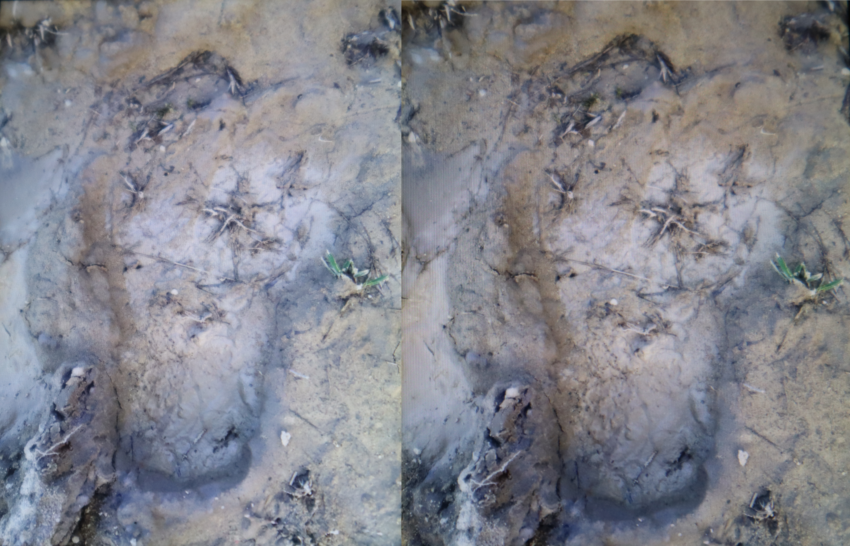
One day on the 4th of July weekend of 2018, either July 6th, 7th, or 8th in 2018, a West Virginia couple found what they purported to be a set of strange large footprints on their property. They found the clearest supposed footprint impression and took a photo of it, though the photo was unfortunately amateurishly done with no size comparison example. (An important reminder to lay down a ruler or something with a known size for scale when taking such photos and to document all the tracks.) This was in Fayette County, West Virginia.
In very early 2020, I obtained the photo from them through a private connection and was told that it was a genuine “Bigfoot” footprint. The couple claimed that it was much larger and wider than a human footprint. They claimed nothing was in that area prior to explain the sudden appearance of the tracks. I was given permission to post this photo and to give my commentary or thoughts on it as well. They asserted that it was a “Bigfoot” and had no other explanation for what it could be. They themselves weren’t Bigfoot researchers or big fans of the topic. They knew of Bigfoot only vaguely through popular culture, as most people do.
I wasn’t very impressed with the imprint myself. To me, it only looked like a Bigfoot track if you were told that’s what you were looking at; without that, it looked more like a large smudge on the ground. It kinda looked to me like an impression from an object that had once been placed down before, like a rock or something. Of course, the purported footprint finders would heavily disagree with this. They asserted there was nothing there before. You might be tempted to conclude that an object was there from the bit of dead grass within the imprint, but note that equally dead grass is also present above and outside of the imprint. The photo had no size comparison to know exactly how large it was, and there were no photos of the other supposed tracks to see any more information, like a potential walking stride.
According to the finders, there were a few other “less defined prints,” but they only photographed the best one. If I’d have been there at the time, I would have of course photographed them all and used a ruler in each photo for scale. The top of the purported track where the “toes” would be, if it was a footprint, wasn’t very well defined. The bottom of the purported track, the supposed “heel” area, is deeply pressed in. The track, to me, doesn’t look like a bear track or other animals, or at least it’s not clear enough to show that.
If this was a walking creature, one would think that the front of the foot would make a deeper impression as it walked forward, unless of course it was strangely walking deeply only on its heel. That might make sense if it was walking down a steep hill or something, but this area was on their property and not on the side of a hill.
I was very skeptical, but I wanted to get other opinions or see what other people thought, since I can be a bit cynical at times.
On March 18th 2020, I posted the image into the Magonia Research Group (MRG) Discord to see what the reaction of the other Fortean researchers there would be. I simply said, “Looking for some feedback, what do you see here?” with no further context yet. I wanted to get their gut reactions without telling them that it was purported to be a Bigfoot print, to see what they thought of it. One user immediately said, “hmmm looks like an object that was there.” I asked if anyone else had a take on it. I said, “Will give context afterwards, just looking for gut reactions to [this] image.” Another user chimed in with their perspective “Yeah I can’t really make it out, it looks like the deep impression of a [shoe][…] or something, followed by a later, shallow impression of something else.”
The first user then replied, “That’s an interesting opinion, it looks like a normal footprint that later got smashed almost entirely by a larger object. At first I thought it wasn’t even a footprint to begin with, but that makes more sense.” I personally don’t agree that it was a human footprint that got smashed; I guess I just go with it being a “large undefined smudge.” I think it still doesn’t make sense for a human print, with the deep heel area, ill-defined toes, and purported large size.
I then explained that the photo was brought to my attention as a possible “Bigfoot track” from a West Virginian couple. Again, they put forth that “some large object smashed the upper part, possibly another footprint.” My assessment at the time was that this was “most likely a compounding of things until this is the final product; resembling a strange footprint through pareidolia and pattern seeking.” Pareidolia is the process by which people see meaningful images or patterns in vague or random visual noise. Like seeing shapes in clouds when cloud gazing, for example. In this instance, it would be seeing large smudges in the ground and thinking they are large footprints, or “Bigfoot” tracks. This isn’t an uncommon occurrence of course, even researchers sometimes think they’ve found odd tracks when they haven’t, and it’s just their human mind playing tricks on them or wanting to see that in their search. Researchers are well aware of this.
I humorously began calling this supposed track “Ol’ Pancake Toes,” jokingly implying that it belonged to a creature with a wedge-shaped foot and thus thin pancake-like toes that don’t make an impression like the deep heel imprint. If the toe area were deeper, even if they were still not very defined, I think I’d find the print much more compelling.
I’m always working on multiple projects, juggling between them, and trying to prioritize the more important. Sometimes it’s just what project I’m able to do then or what strikes my fancy at the time. Sometimes I’m waiting to get more information first. I put this purported footprint photo on the proverbial back burner for a while, focusing on other things instead. As I said, I wasn’t too impressed with it, so I didn’t prioritize it. I figured an article on the photo wouldn’t be too interesting or exciting. Though eventually I thought maybe just a quick article on it would be at least somewhat neat or useful somehow. Might as well.
In early 2026, I began deep diving yet again into West Virginia Bigfoot and Bigfoot in general. My attention soon returned to the subject of this purported West Virginia Bigfoot track. I’d only posted it in the Magonia Research Group and hadn’t done anything else with it yet. I then posted it in a Bigfoot Discord group and several Bigfoot Facebook groups to get more feedback. The Bigfoot Discord group I posted it in wasn’t too impressed with it either, though one user, not ruling it out, said: “it could be a Bigfoot track.”
One Facebook user, implying that the imprint came from an intruder on the couple’s property, proclaimed it to be a “poacher boot print.” As I’ve mentioned, the print finders claimed that it was much larger and wider than a human footprint, though the photo has no size comparison. Another user said it “looks like a double step from a bear.” The famous bear double-step is something that most Bigfoot researchers keep in mind and watch out for when collecting purported tracks. When a bear steps down its paw twice in the same place, it can make a large semi-human-like footprint, which can be mistaken for a Bigfoot print, though there are some tell-tale signs of this in such prints if you can look closely, and usually other clearer bear tracks are around as well. It’s something for researchers to definitely be on the look out for.
I don’t think this imprint looks like a bear double step, because the toes aren’t visible at all, and because the bear double-step tracks I’ve seen have a more pointed or triangle-like end to them rather than the very rounded or rectangular end of the deep “heel” area impression in the photo. Ultimately, I think this imprint is much too vague to make any super precise analysis. I can at least say that it doesn’t look like dog or cat tracks for example or other such animals with very identifiable tracks. I still see it more as an impression than a footprint.
With that being said, allow me to speculate wildly for a moment with the clear disclaimer that this can’t be precise at all. I brought up this purported footprint in a voice-chat room in a monster-themed Discord and discussed it with those folks to hear their thoughts. One user pointed out something interesting that I hadn’t fully considered. They said that you can kind of get an idea of the size to some extent based vaguely on the grass in the photo, particularly the bit of green grass sticking up to the right of the imprint. This gave me an idea, so I pulled up the photo in a photo editor. I copied and pasted the bit of grass repeatedly across the purported footprint. If we take the grass to be very roughly an inch and repeatedly paste it across the impression to scale, it would take roughly thirteen instances of this grass blade from the heel area to the vague toe area. By doing this, we turn the grass blade into a very rough makeshift ruler.
This could hypothetically mean that this imprint is very roughly 13 inches long, 8 inches wide in the widest place, and 5 inches wide in the heel, if we indeed took that grass blade there to be roughly an inch, but we can’t know that for sure. That would be only a very rough estimate of size, with the assumption that the grass blade is roughly an inch long. Of course, we don’t know how long that blade of grass truly was, so that is very speculative, but I think it’s worth mentioning or worth a try to get some kind of idea of what the size could possibly be. It’s a very inventive attempt to speculatively measure with a blade of grass as a ruler. At 13 inches long, it does seem to fall in line with the typical sizing of famous Bigfoot plaster cast footprints. It would also line up with the finder’s saying that it was larger and wider than an average human footprint. Once again, the measurement attempt is incredibly speculative.
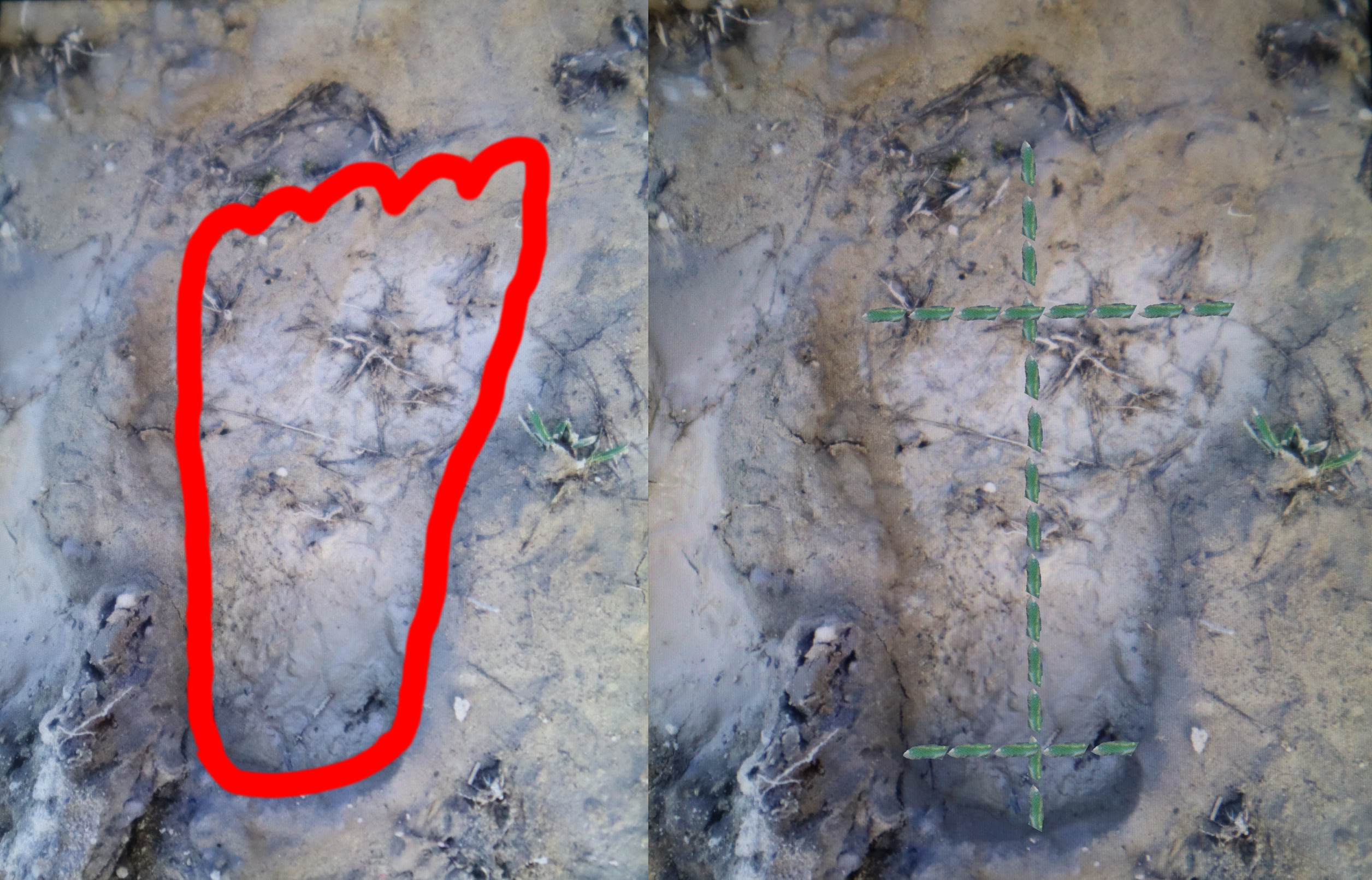
Another thing I tried was to draw a red outline around the purported footprint, looking very carefully at the outline of the impression within the ground. Once that is done, it does look more like a Bigfoot track, and you can see where five toes might be, but once again, that’s only when you’re really looking very closely and with a large footprint in mind, so it could easily be a product of pareidolia. I tried my absolute best to trace only the outline, logically where the imprint stops, separating the print from the rest of the ground, and the foot outline with five toes is what I’m left with. The deep “heel” impression and light “toes” area just don’t make sense to me, and that’s my main reason for considering this impression most likely pareidolia. Presently, I don’t think the purported footprint photo can really be counted as a datapoint when mapping Bigfoot sightings in West Virginia. But then again, who am I to say so? I’m just one researcher.
One Discord user in one of the two monster-themed groups I posted the photo in said, “It’s definitely interesting. I couldn’t really say what would make that. There’s no explanation that I could think of.” A different user commented, “Yeah, that’s not like a regular guy’s foot.” Someone else said, “I do think it’s interesting. Because you can’t really tell what it is.” Yet another user said, “It’s obviously not a human foot and it’s obviously not a bear. So I would say it’s unknown.” One more person commented, “It doesn’t look human and it doesn’t look like any animal I’ve seen.”
Those two groups seemed to find it more fascinating and truly puzzling as a mystery, but none of them thought that it definitely had to be a Bigfoot. They seemed to agree that it didn’t look like a print from a human or other clearly identifiable animal. They were open to the idea that it could be something anomalous, even if it was an unclear example. I still don’t know. So I’ve made this article to collect all my thoughts on the matter and put the ball in your court, so to speak. I think it’s at least interesting enough to put out there or make available and to write an article about, if nothing else than to document my experience and my thinking process of looking it over, investigating it, or questioning it in any way I could, as well as other people’s very different thoughts and reactions to the same purported footprint image. So, there you go.
Even if this was a real Bigfoot footprint, the photo wouldn’t prove anything. Still, it’s an interesting curiosity to wonder about, and if nothing else, it’s an interesting artifact as a test of sorts for critical thinking and skeptical examination. The strange claim attached to it makes it fascinating, and the photo of course brings many more questions than answers. I think it’s fun to show this image to people and get their thoughts on it; it’s like a Bigfoot Rorschach test. As a West Virginian, the location is of course very intriguing to me as well, and is something that made me want to look into it deeper and ask more. The idea of such creatures being in my home state captures my imagination.
Are there really Bigfoot in West Virginia? The question is still open, and we are no closer.