
[Context: The Beast of Gevaudan is a purported beast that reportedly attacked people in the region of Gevaudan in France in 1764 before being shot and killed in September of 1765. Many called the creature a wolf but others thought it to be a hyena. Whatever the case, the story became very influential in Werewolf lore.]
The following are engravings, woodcuts, and printed images from the 1760’s which tell the story of the Gevaudan beast:
[1764] The Beast of Gévaudan
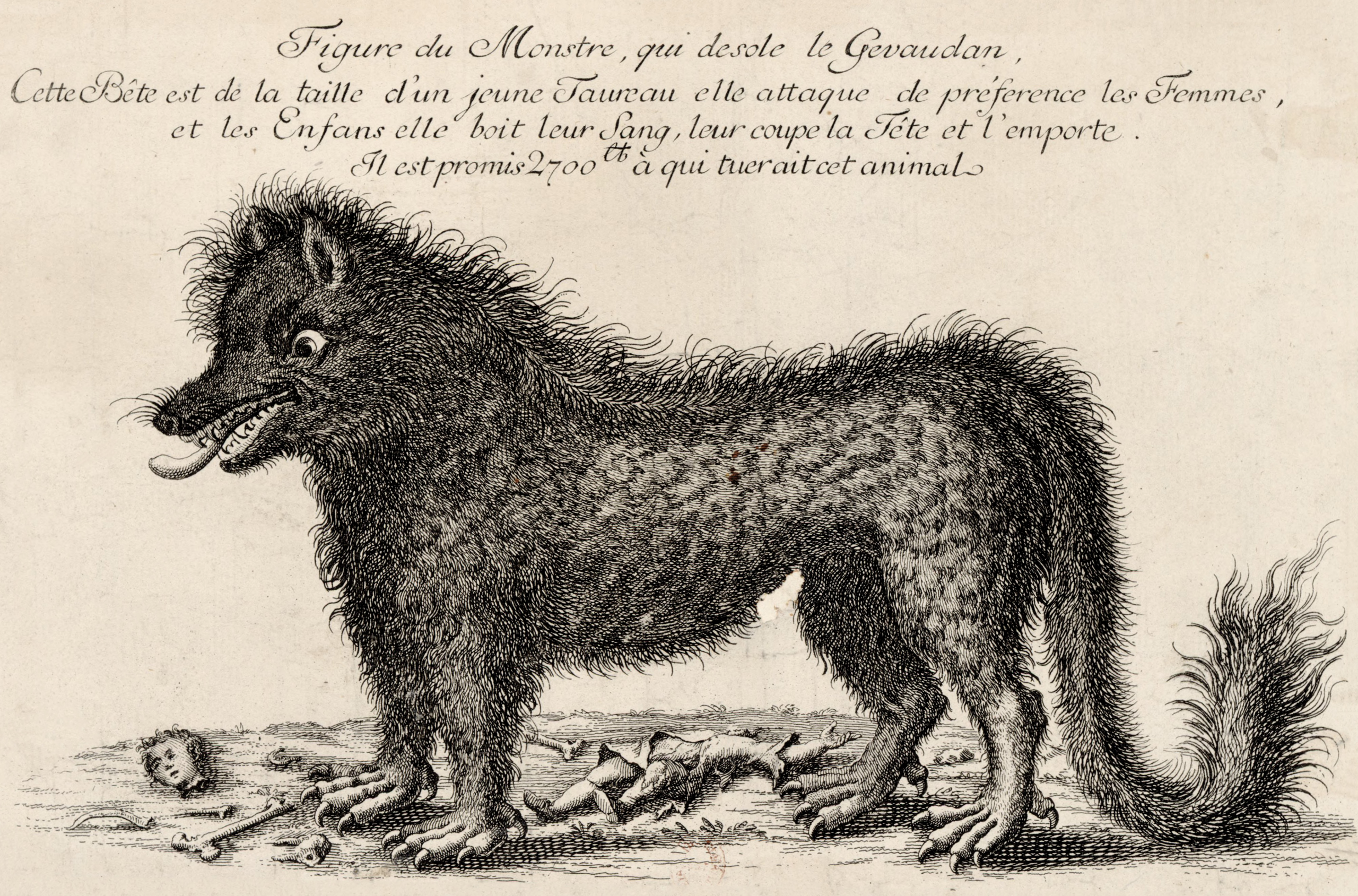
French Text: Figure du Monstre, dui desole le Gévaudan, Cette Bete est de la taille d’un jeune Taureau elle attaque de preference les Femmes, et les Enfans elle boit leur Sang, leur coupe la tete et l’emporte. ll est promis 2700 it a qui tuerait cet animal
Translated Into English: A monstrous figure that has been ravaging the Gevaudan: this Beast is the size of a young bull. It prefers to attack women and children; it drinks their blood, severs their heads, and carries them off. A reward of 2,700 is promised to whoever kills this animal.
Source(s): https://commons.wikimedia.org/wiki/File:Figure_du_monstre_qui_d%C3%A9sole_le_Gevaudan.jpg
[May 1765] Engraving from The London Magazine, Vol. XXXIV (34)
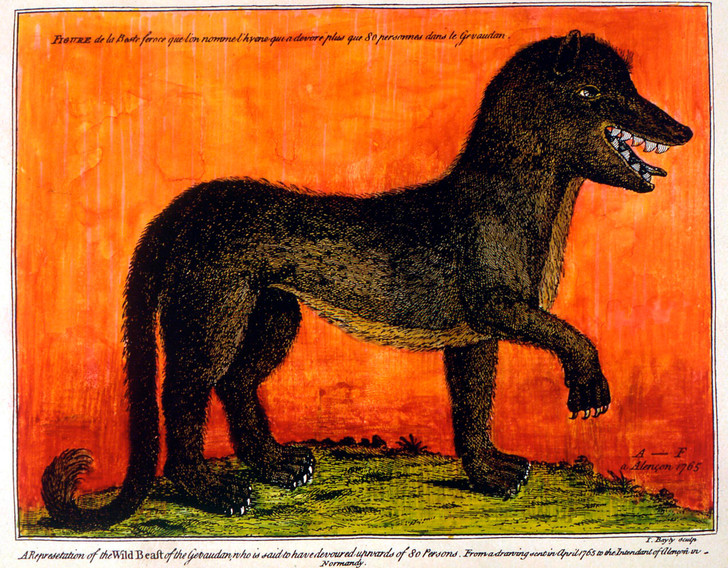
French Text: Figure de la baste feroce que l’on nommel hyane que a devore plus que 80 personnes dans le Gévaudan
Translated Into English: Depiction of the ferocious beast known as the hyena, which devoured more than 80 people in the Gevaudan.
A representation of the Wild Beast of the Gevaudan who is said to have devoured upwards of 80 Persons. From a drawing sent in April 1765 to the [illegible] of [illegible] – Normandy. (Drawn by AF – 1765) [Note: This image was later reprinted in the influential book “Werewolf (1933)” by Montague Summers.]
Source(s): https://commons.wikimedia.org/wiki/File:B%C3%AAte_du_G%C3%A9vaudan_-_The_London_Magazine.jpg
[Circa 1765] Print showing the beast of Gévaudan attacking a woman:
French Text:
A Paris Chez Basset Sue. (S. Jacques A S. Genevieve)
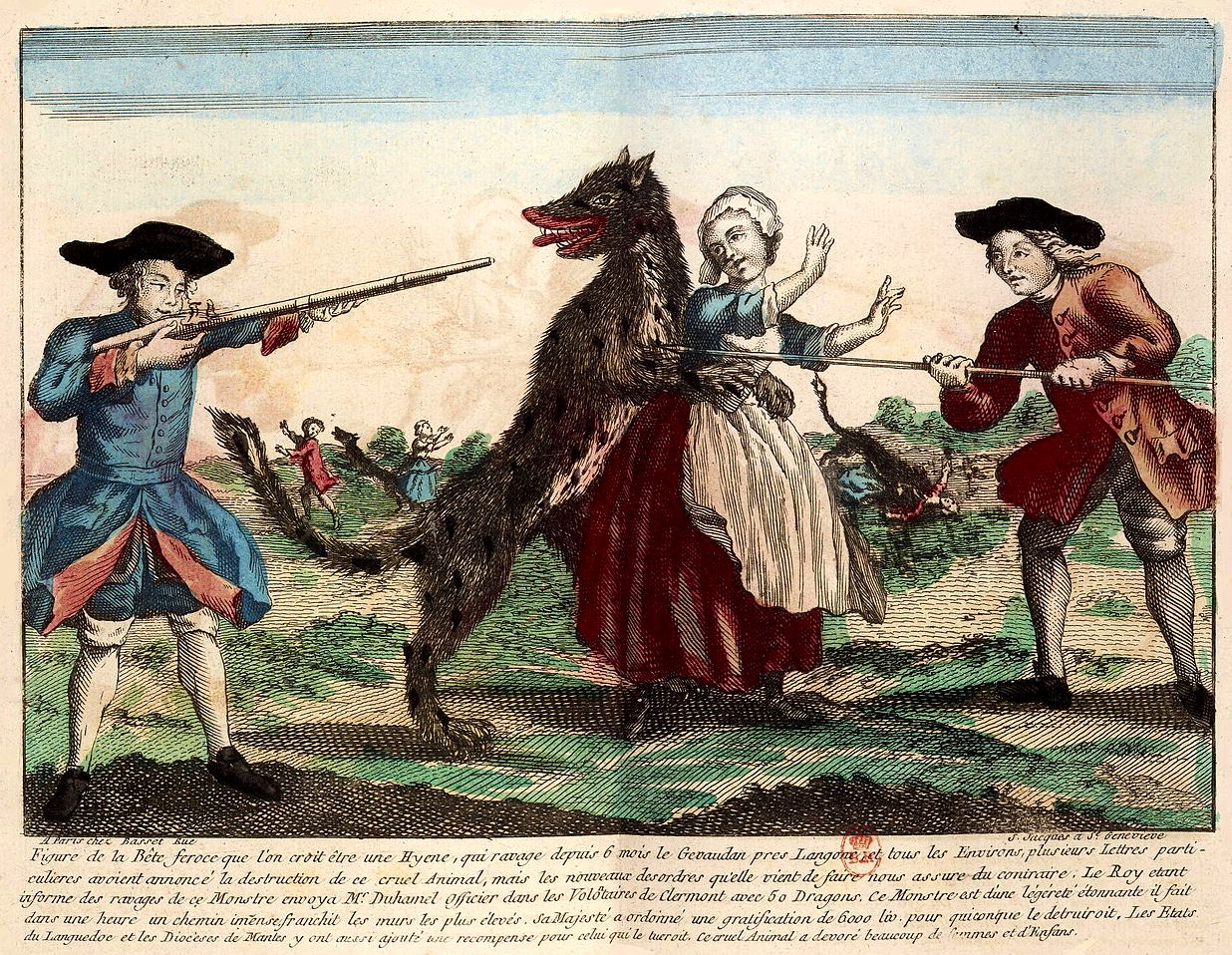
Figure de la Bete feroce que l’on croit etre une hyena, qui ravage depuis 6 mois le Gévaudan pres Langone et tous les envisons, plusieurs Lettres particulieres avoient annonce la destruction de ce cruel Animal, mais les rouveaur desordres qu’elle vient de fair nouse assure du coniraire. Le Roy etant informe des ravages de ce Monstre envoya Mr Duhanel Officier dans les Volotaires de Clermont avec 5 o Dragons. Ce Monstre est gune legerete etonnante il fait fans une heure un chemin immense. franchit les murs les plus eleves. SaMajeste a ordonne une gratification de 6000 liv pour quiconque le destruiroit, Les Etats du Languedoc et les Dioceses de Mantes y ont aussi ajoutz une recompense pour celuiquile tueroit. le curel animal a devore beaucoup de lemmes et d’enfans.
Translated into English:
In Paris, at Basset’s shop. (Rue Saint-Jacques, near Sainte-Geneviève)
Depiction of the ferocious beast—believed to be a hyena—that has been ravaging the Gevaudan region (near Langogne) and its surroundings for six months. While several private letters had announced the destruction of this cruel animal, the fresh havoc it has just wreaked proves otherwise. Informed of the monster’s depredations, the King dispatched Monsieur Duhamel—an officer in the Clermont Volunteers—along with fifty dragoons[*]. The monster possesses astonishing agility, covering vast distances in a single hour and clearing even the highest walls. His Majesty has ordered a reward of 6,000 livres[**] for anyone who destroys it; the Estates of Languedoc and the Diocese of Mende have also pledged a reward for the person who kills it. The cruel animal has devoured many women and children.
[*] “Dragoon” meaning mounted infantry of the French Army, soldiers on horseback.
[**] “Livre” refers to the French currency used at the time. (Before being replaced by the Franc in 1795.)
Source(s): https://commons.wikimedia.org/wiki/File:Recueil_Magn%C3%A9_de_Marolles_-_Figure_de_la_b%C3%AAte_f%C3%A9roce.jpg
[Circa 1765] Print depicting the story of the Beast of Gévaudan
French Text:
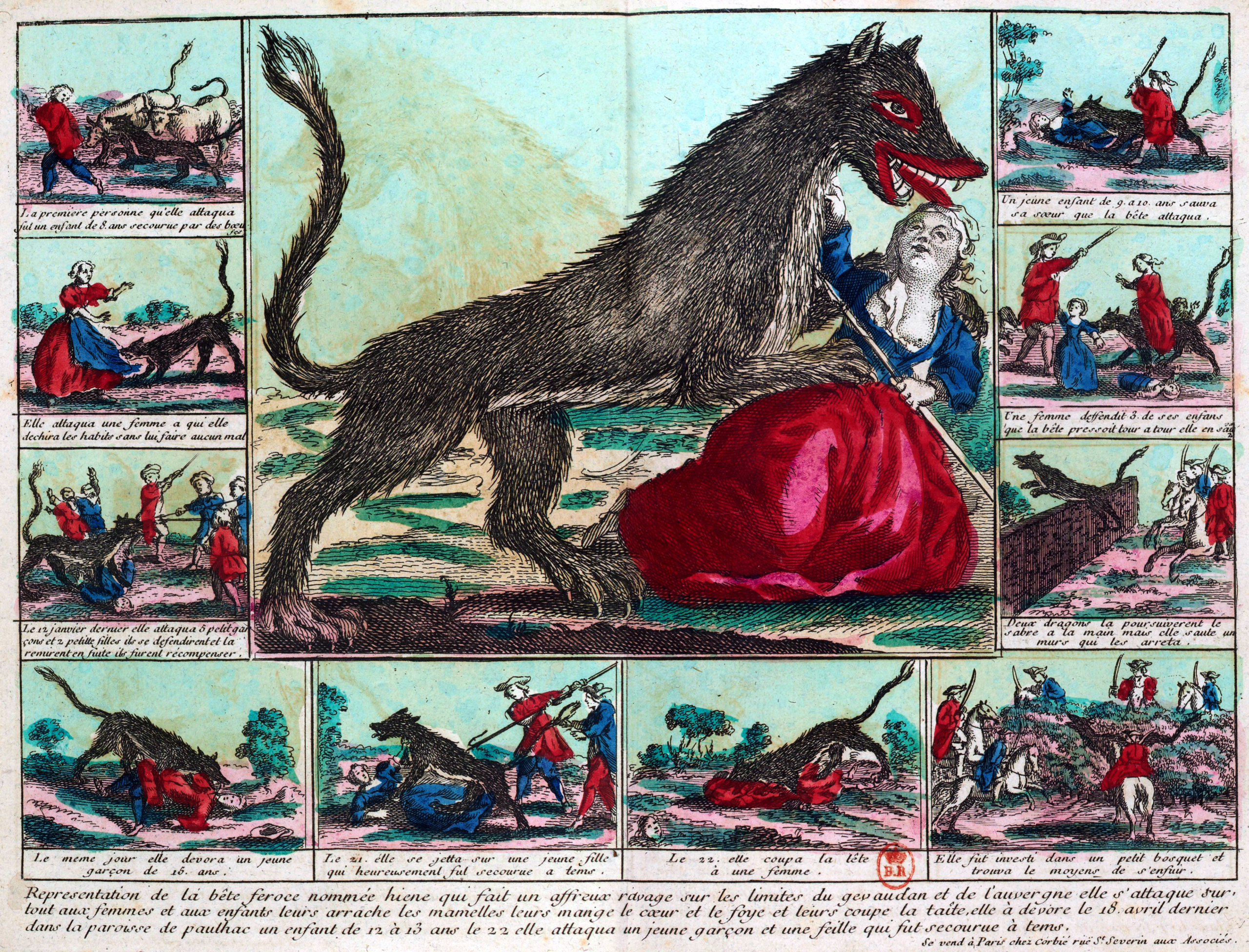
Representation de la bete feroce nommee hiene qui fait un affreux ravage sur les limites du gev audan et de Lauvergne elle s attaque sur, tout aux femmes et aux enfants leurs arrache les mamelles leurs mange le Coeur et le foye et leurs coupe la taite, elle a devore le 18. avril dernier dans la paroisse de paulhac un enfant de 12 a 13 ans le 22 elle attaque un jeune garcon et une faille qui fut secourue a tems
Se vend a Paris chez Corbie rue S. Severin aux associe’s.
(From left to right)
1. La premiere personne quelle Altaqua ful en enfant de 8 ans secourue par des beu fes
2. Un jeune enfant de 9 a 10 ans sauva sa soeur que la bete attaqua.
3. Elle altaqua une femme a qui elle dechiara les habits sans lui faire aucun mal
4. Une femme deffendit 3. de ses enfans que la bete pressoit tour a tour elle en sauva 2
5. Le 12 Janvier dermer elle altaqua 5 pelit gar cons et 2 pelitte filles its se defendirentet la remirent en fuite ils furent recompenser
6. Deux dragons la poursuiverent le sabre a la main mais elle saute un murs qui les arreta.
7. Le meme jour elle Devora un jeune garcon de 15 ans
8. Le 21 elle se jetta sur une jeune fille qui heureusement fut secourue a tems
9. Le 22. ette coupa la tete a une femme.
10. Elle fut investi dans un petit bosquet et trouva le moyens de senfuir.
Translated To English:
Depiction of the ferocious beast known as the hyena, which is wreaking terrible havoc along the borders of Gevaudan and Auvergne; it targets women and children in particular, tearing off their breasts, eating their hearts and livers, and severing their heads. On April 18th, in the parish of Paulhac, it devoured a child aged 12 or 13; on the 22nd, it attacked a young boy and a girl, who was rescued in time.
Sold in Paris by Corbie, Rue Saint-Séverin, and associates.
(From left to right)
1. The first person it attacked was an 8-year-old child, who was rescued by shepherds.
2. A young child, aged 9 or 10, saved his sister when the beast attacked her.
3. It attacked a woman, tearing her clothes but causing her no physical harm.
4. A woman defended three of her children whom the beast was harrying in turn; she saved two of them.
5. On January 12th, it attacked five young boys and two young girls; they defended themselves and drove it away, and were rewarded.
6. Two dragoons[*] pursued it, sabers in hand, but it leapt over a wall that stopped them.
7. That same day, it devoured a 15-year-old boy.
8. On the 21st, it lunged at a young girl who was fortunately rescued in time.
9. On the 22nd, it severed a woman’s head.
10. It was cornered in a small grove but managed to escape.
[*] “Dragoon” meaning mounted infantry of the French Army, soldiers on horseback.
Source(s): https://commons.wikimedia.org/wiki/File:B%C3%AAte_du_G%C3%A9vaudan.jpg
[Circa 1765] Print depicting François Antoine slaying the Beast of Gévaudan on September 21st 1765, in Chazes, Gévaudan, France:
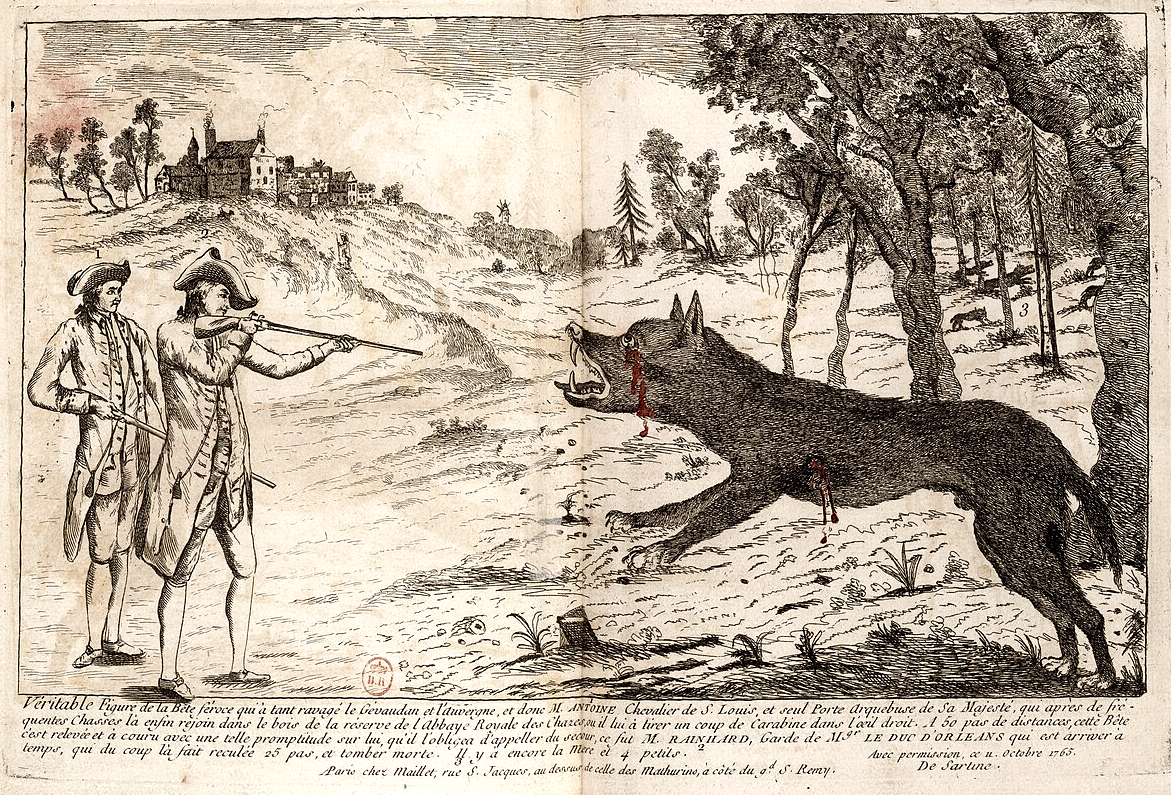
French Text:
Veritable Figure de la bete feroce qui a tant ravage le Gévaudan et l’auvergne, et done M. Antoine Chevalier de S. Louis, et seul Porte Arquebuse de sa majeste, qui apres de frequentes Chasses la enfin rejoin dans le boi de la reserve del Abbaye Royale des Chazesouil lui a tirer un coup de Carabine dans loeil droit. A 50 pas de distances, cette Bete cest relevicet a couru avec une telle promptitude sur lui, quil lobligea dappeller du secour, ce fut M. Rainhard, garde de M9 Le Duc dorleans qui est arriver a temps, qui de coup la fait reculee 25 pas, et tomber morte. ll ya encore la mere et 4 petits.
Paris chez maillet, rue S. Jacques au dessus de celle des Mathurino, a cote du gd S. Remy. Avec permission ce u. octobre 1765. De Sartune.
Translated into English:
An accurate depiction of the ferocious beast that wreaked such havoc in the Gevaudan and Auvergne regions, and which was finally brought down by Monsieur Antoine—Knight of the Order of Saint Louis and His Majesty’s sole Arquebus-bearer. After numerous hunts, he caught up with the creature in the woods of the Royal Abbey of Chazes reserve and fired a carbine shot into its right eye from a distance of fifty paces. The beast rose again and charged at him with such speed that he was forced to call for help; Monsieur Rainhard—a gamekeeper for the Duke of Orléans—arrived in time and, with a single shot, drove the animal back twenty-five paces and brought it down dead. The mother and four cubs remain at large.
Paris: Published by Maillet, Rue Saint-Jacques (above Rue des Mathurins, next to Grand Saint-Rémy). With permission, this October 1765. De Sartine.
Source(s): https://commons.wikimedia.org/wiki/File:Recueil_Magn%C3%A9_de_Marolles_-_V%C3%A9ritable_figure_de_la_b%C3%AAte_f%C3%A9roce_qui_a_tant_ravag%C3%A9_le_G%C3%A9vaudan.jpg
[Circa 1765] Wolf of Chazes, shot by M. François Antoine de Beauterne, displayed at the court of Louis XV
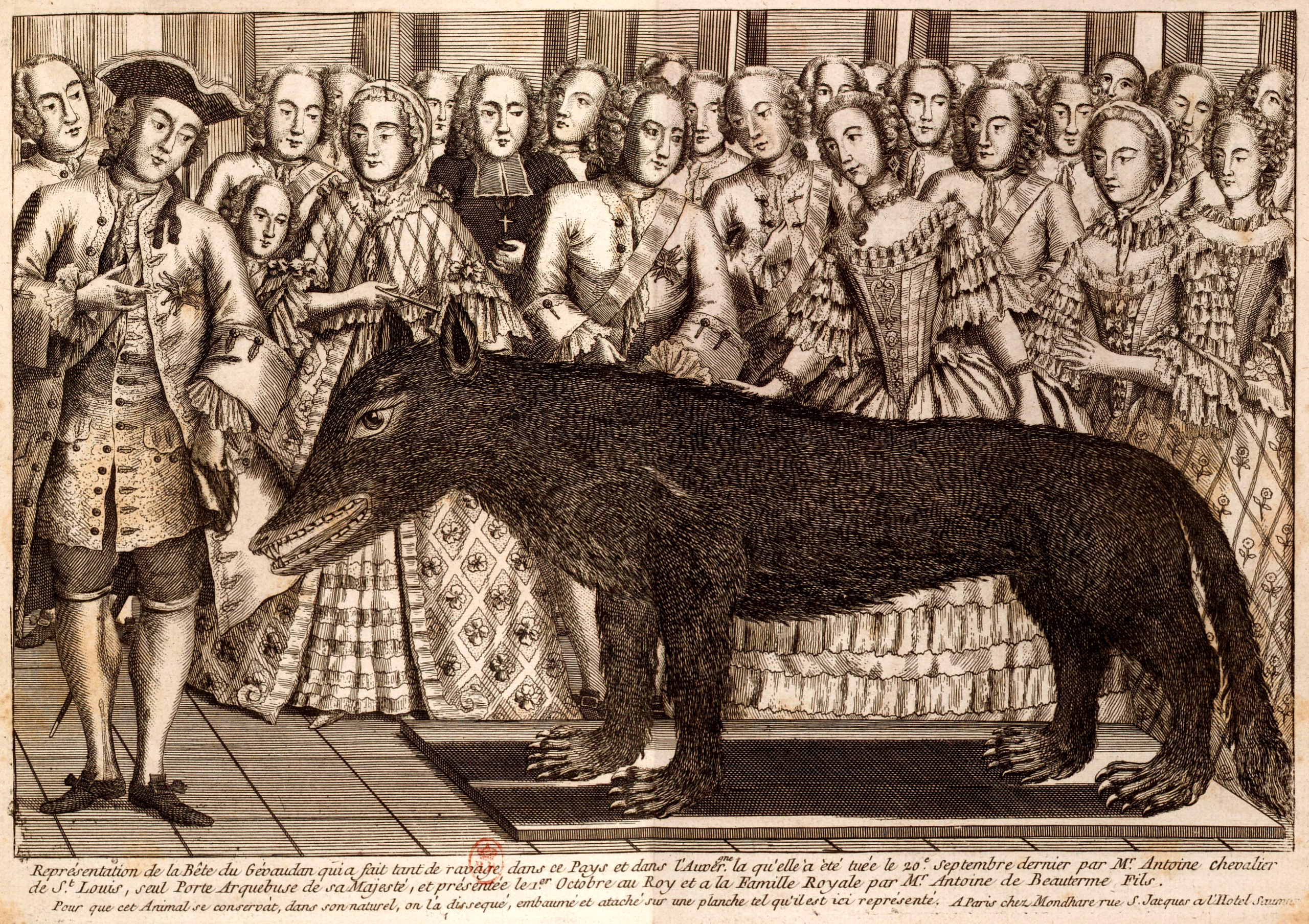
French Text:
Representation de la Bete du Gévaudan quia fait tant de ravage dans ce pays et dans l’Auvergne, la que’lle ‘a ete tuee le 20 e septembre dernier par M. Antoine chevalier de S.t Louis, seul Porte Arquebuse de sa Majeste, et presentee le 1er Octobre au Roy et a la Famille Royale par Mr. Antoine de Beauterme Fils. Pour que cet Animal se sonseroat, dans son naturel, on l’a disseque, embaume et attache sur une planche tel qu’ilest ici represente. À Paris chez Mondhare rue S. Jacques al’Hotel Saumrer
Translated Into English:
Depiction of the Beast of Gevaudan, which wreaked such havoc in that region and in Auvergne; it was killed on the 20th of last September by M. Antoine, Knight of Saint Louis and His Majesty’s sole Arquebus-Bearer, and presented to the King and the Royal Family on October 1st by M. Antoine de Beauterne the Younger. To preserve the animal in its natural state, it was dissected, embalmed, and mounted on a board, just as it is depicted here. In Paris, at Mondhare’s, Rue Saint-Jacques, Hôtel Saumrer.
Source(s): https://commons.wikimedia.org/wiki/File:Wolf_of_Chazes.jpg
[Circa 1765] The Beast of Gévaudan Depicted Instead As Man-Like
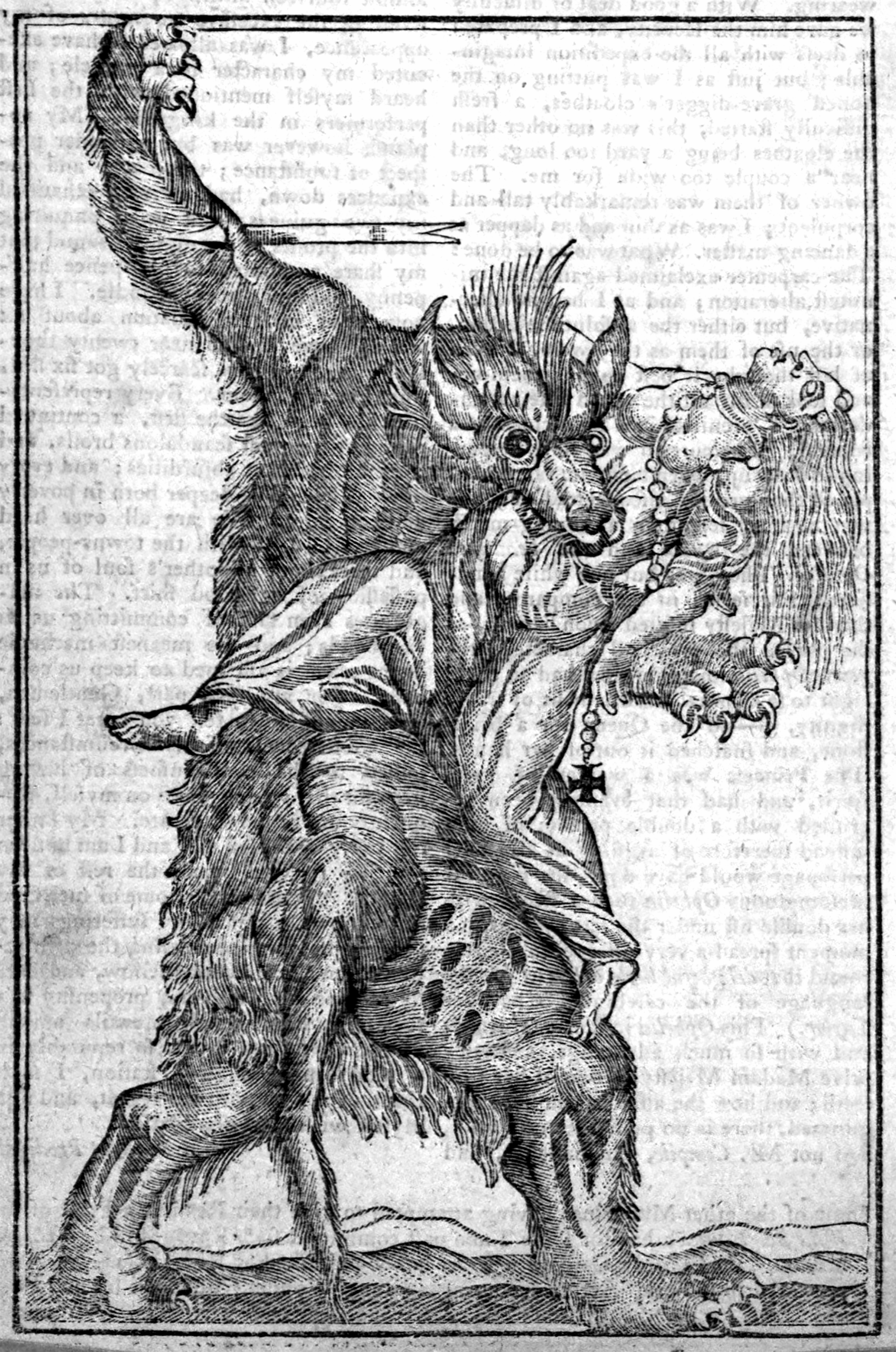
Caption: “An exact Representation of the WILD BEAST now in France, in the Act of devouring a young Woman.” [Note: this man-like or humanoid look was not how the beast was originally described.]
Source(s): https://commons.wikimedia.org/wiki/File:Loup_garou.jpg
Disclaimer: The above material was published prior to 1931. Under United States copyright law (specifically the 95-year rule), this work has entered the public domain and is thus free to use or republish. It is presented here as an interesting and folkloric oddity.
Note: There is also a book excerpt from “The Queen’s Cadet and Other Tales (1874) by James Grant” about the Beast of Gevaudan available on this archive.
Categories: Werewolves, Book Excerpts