
The Washington Times (Washington [D.C.]), November 6th 1921
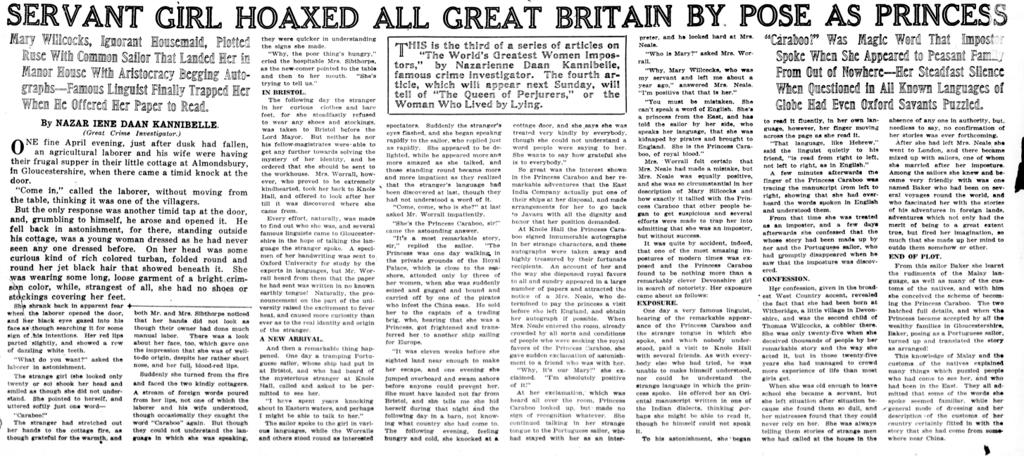
Servant Girl Hoaxed All Great Britain By Pose As Princess
Mary Willcocks, Ignorant Housemaid, Plotted Ruse With Common Sailor That Landed Her in Manor House With Aristocracy Begging Autographs – Famous Linguist Finally Trapped Her When He Offered Her Paper to Read.
This is the third of a series of articles on “The World’s Greatest Women Impostors,” by Nazarlenne Daan Kannibelle, famous crime investigator. The fourth article, which will appear next Sunday, will tell of “The Queen of Perjurers,” or the Woman Who Lived by Lying.
By Nazar Iene Daan Kannibelle
(Great Crime Investigator.)
One fine April evening, just after dusk had fallen, an agricultural laborer and his wife were having their frugal supper in their little cottage at Almondsbury, in Gloucestershire, when there came a timid knock at the door.
“Come in,” called the laborer, without moving from the table, thinking it was one of the villagers.
But the only response was another timid tap at the door, and, grumbling to himself, he arose and opened it. He fell back in astonishment, for there, standing outside his cottage, was a young woman dressed as he had never seen any one dressed before. On her head was some curious kind of rich colored turban, folded round and round her jet black hair that showed beneath it. She was wearing some long, loose garment of a bright crimson color, while, strangest of all, she had no shoes or stockings covering her feet.
She shrank back in apparent fear when the laborer opened the door, and her black eyes gazed into his face as though searching it for some sign of his intentions. Her red lips parted slightly, and showed a row of dazzling white teeth.
“What do you want?” asked the laborer in astonishment.
The strange girl (she looked only twenty or so) shook her head and smiled as though she did not understand. She pointed to herself, and uttered softly just one word –
“Caraboo.”
The stranger had stretched out her hands to the cottage fire, as though grateful for the warmth, and both Mr. and Mrs. Sibthorpe noticed that her hands did not look as though their owner had done much manual labor. There was a look about her face, too, which gave one the impression that she was of well-todo origin, despite her rather short nose, and her full, blood-red lips.
Suddenly she turned from the fire and faced the two kindly cottagers. A steam of foreign words poured from her lips, not one of which the laborer and his wife understood, though occasionally they caught the word “Caraboo” again. But though they could not understand the language in which she was speaking, they were quicker in understanding the signs she made.
“Why, the poor thing’s hungry,” cried the hospitable Mrs. Sibthorpe as the new-comer printed to the table and then to her mouth. “She’s trying to tell us.”
In Bristol.
The following day the stranger in her curious clothes and bare feet, for she steadfastly refused to wear any shoes and stockings, was taken to Bristol before the Lord Mayor. But neither he nor his fellow magistrates were able to get any further towards solving the mystery of her identity, and he ordered that she should be sent to the workhouse. Mrs. Worrall, however, who proved to be extremely kindhearted, took her back to Knole Hall, and offered to look after her till it was discovered where she came from.
Every effort, naturally, was made to find out who she was, and several famous linguists came to Gloucestershire in the hope of talking the language the stranger spoke. A specimen of her handwriting was sent to oxford University for study by the experts in languages, but Mr. Worrall heard from them that the paper he had sent was written in no known earthly tongue! Naturally, the pronouncement on the part of the university raised the excitement to fever heat, and caused more curiosity than ever as to the real identity and origin of the stranger.
A New Arrival.
And then a remarkable thing happened. One day a tramping Portuguese sailor, whose ship had put in at Bristol, and who had heard of the mysterious stranger at Knole Hall, called and asked to be permitted to see her.
“I have spent years knocking about in Eastern waters, and perhaps I might be able to talk to her,”
The sailor spoke to the girl in various languages, while the Worralls and others stood round as interested spectators. Suddenly the stranger’s eyes flashed, and she began speaking rapidly to the sailor, who replied just as rapidly. She appeared to be delighted, while he appeared more and more amazed as she talked, and those standing around became more and more impatient as they realized that the stranger’s language had been discovered at last, though they had not understood a word of it.
“Come, come, who is she?” at last asked Mr. Worrall impatiently.
“She’s the Princess Caraboo, sir!” came the astounding answer.
“It’s a most remarkable story, sir,” replied the sailor. “The Princess was one day walking in the private grounds of the Royal Palace, which is close to the sea shore, attended only by three of her women, when she was suddenly swiped and gagged and bound and carried off by one of the pirates who infest the China seas. He sold her to the captain of a trading brig, who, hearing that she was a Princess, got frightened and transferred her to another ship sailing for Europe.
“It was eleven weeks before she sighted land near enough to make her escape, and one evening she jumped overboard and swam ashore before anyone could prevent her. She must have landed not far from Bristol, and she tells me she hid herself during that night and the following day in a barn, not knowing what country she had come to.
The following evening, feeling hungry and cold, she knocked at a cottage door, and she says she was treated very kindly by everybody, through she could not understand a word people were saying to her. She wants to say how grateful she is to everybody.”
So great was the interest shown in the Princess Caraboo and her remarkable adventures that the East India Company actually put one of their ships at her disposal, and made arrangements for her to go back to Javasu with all the dignity and honor that her position demanded.
At Knole Hall the Princess Caraboo signed innumerable autographs in her strange characters, and these autographs were taken away and highly treasured by their fortunate recipients. An account of her and the way she disappeared royal favors to all and sundry appeared in a large number of papers and attracted the notice of a Mrs. Neale, who determined to pay the princess a visit before she left England, and obtain her autograph if possible. When Mrs. Neale entered the room, already crowded by all sorts and conditions of people who were seeking the royal favors of the Princess Caraboo, she gave sudden exclamations of astonishment to a friend who was with her.
“Why, it’s our Mary.” she exclaimed. “I’m absolutely positive of it!”
At her exclamation, which was heard all over the room, Princess Caraboo looked up, but made no sign of recognition whatever. She continued talking in her strange tongue to the Portuguese sailor, who had stayed with her as an interpreter, and he looked hard at Mrs. Neale.
“Who is Mary?” asked Mrs. Worrall.
“Why, Mary Willcocks, who was my servant and left me about a year ago,” answered Mrs. Neale. “I’m positive that that is her.”
“You must be mistaken. She can’t speak a word of English. She’s a princess from the East, and has told the sailor by her side, who speaks her language, that she was kidnapped by pirates and brought to England. She is the Princess Caraboo, of royal blood.”
Mrs. Worrall felt certain that Mrs. Neale had made a mistake, but Mrs. Neale was equally positive and she was so circumstantial in her description of Mary Willcocks and how exactly it tallied with the Princess Caraboo that other people began to get suspicious and several efforts were made to trap her into admitting that she was an imposter, but without success.
It was quite by accident, indeed, that one of the most amazing impostures of modern times was exposed and the Princess Caraboo found to be nothing more than a remarkably clever Devonshire girl in search of notoriety. Her exposure came about as follows:
Exposure.
One day a very famous linguist, hearing of the remarkable appearance of the Princess Caraboo and the strange tongue in which she spoke, and which nobody understood, paid a visit in Knole Hall with several friends. As with everybody else who had tried, he was unable to make himself understood, nor could he understand the strange language in which the princess spoke. He offered her an Oriental manuscript written in one of the Indian dialects, thinking perhaps she might be able to read it, though he himself could not speak it.
To his astonishment, she began to read it fluently, in her own language, however, her finger moving across the page as she read it.
“That language, like Hebrew,” said the linguist quietly to his friend, “is read from right to left, not left to right, as in English.”
A few minutes afterwards the finger of the Princess Caraboo was tracing the manuscript from left to right, showing that she had overheard the words spoken in English and understood them.
From that time she was treated as an imposter, and a few days afterwards she confessed that the whole story had been made up by her and the Portuguese sailor, who had promptly disappeared when he saw that the imposture was discovered.
Confession.
Her confession, given in the broadest West Country accent, revealed the fact that she had been born at Witheridge, a little village in Devonshire, and was the second child of Thomas Willcocks, a cobbler there. She was only twenty-five when she deceived thousands of people by her remarkable story and the way she acted it, but in those twenty-five years she had managed to crowd more experience of life than most girls get.
When she was old enough to leave school she became a servant, but she left situation after situation because she found them so dull, and her mistresses found that they could never rely on her. She was always telling them stories of strange men who had called at the house in the absence of any one in authority, but needless to say, no confirmation of her stories was ever forthcoming.
After she had left Mrs. Neale she went to London, and there became mixed up with sailors, one of whom she married after her imposture. Among the sailors she knew and became very friendly with was one named Baker who had been on several voyages round the world, and who fascinated her with the stories of his adventures in foreign lands, adventures which not only had the merit of being to a great extent true, but fired her imagination, so much that she made up her mind to outdo them somehow or other.
End of Plot.
From this sailor Baker she learned the rudiments of the Malay language, as well as many of the customs of the natives, and with him she conceived the scheme of becoming the Princess Caraboo. The two hatched full details, and when the Princess became accepted by all the wealthy families in Gloucestershire, Baker, posing as a Portuguese sailor, turned up and translated the story as arranged.
This knowledge of Malay and the customs of the natives explained many things which puzzled people who had come to see her, and who had been in the East. They all admitted that some of the words she spoke seemed familiar, while her general mode of dressing and her description of the customs of her country certainly fitted in with the story that she had come from somewhere near China.
Disclaimer: This 1921 newspaper article was published prior to 1931. Under United States copyright law (specifically the 95-year rule), this work has entered the public domain and is thus free to use or republish. It is presented here as an interesting and folkloric newspaper oddity.
Source(s): https://www.loc.gov/resource/sn84026749/1921-11-06/ed-1/?sp=25
Categories: Newspapers, Mysterious Strangers, Princess Caraboo, Hoaxes