
The Bismarck Tribune (Bismarck, N.D.), July 17th 1924
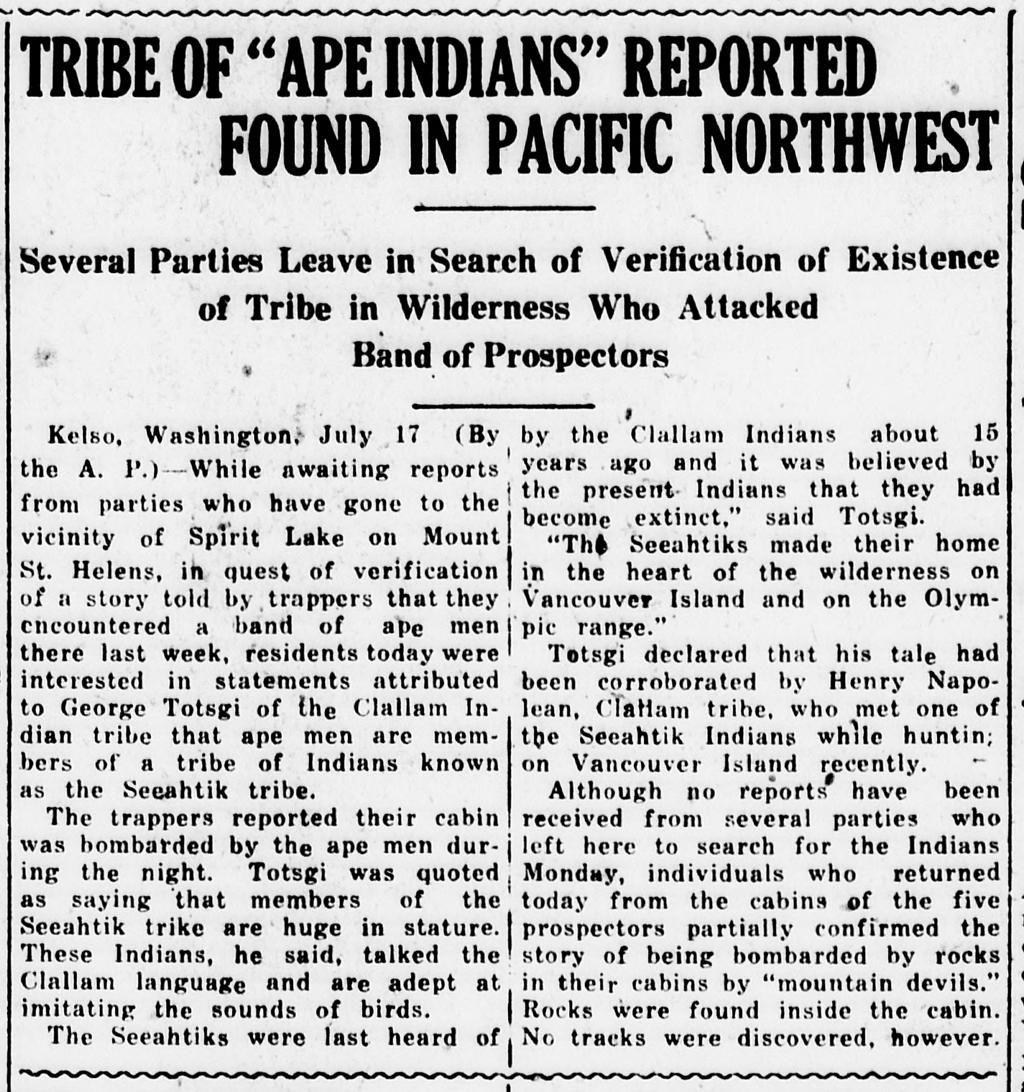
Tribe of “Ape Indians” Reported Found In Pacific Northwest
Several Parties Leave in Search of Verification of Existence of Tribe in Wilderness Who Attacked Band of Prospectors
Kelso, Washington, July 17 (By the A. P.) – While awaiting reports from parties who have gone to the vicinity of Spirit Lake on Mount St. Helens, in quest of verification of a story told by trappers that they encountered a band of ape men there last week, residents today were interested in statements attributed to George Totsgi of the Clallam Indian[*] tribe that ape men are members of a tribe of Indians known as Seeahtik tribe.
The trappers reported their cabin was bombarded by the ape men during the night. Totsgi was quoted as saying that members of the Seeahtik tribe are huge in stature. These Indians, he said, talked the Clallam language and are adept at imitating the sounds of birds.
‘The Seeahtiks were last heard of by the Clallam Indians about 15 years ago and it was believed by the present Indians that they had become extinct,” said Totsgi.
“The Seeahtiks made their home in the heart of the wilderness on Vancouver Island and on the Olympic range.”
Totsgi declared that his tale had been corroborated by Henry Napolean, Clallam tribe, who met one of the Seeahtik Indians while hunting on Vancouver Island recently.
Although no reports have been received from several parties who left here to search for the Indians Monday, individuals who returned today from the cabins of the five prospectors partially confirmed the story of being bombarded by rocks in their cabins by “mountain devils.”
Rocks were found inside the cabin. No tracks were discovered however.
Disclaimer: This 1924 newspaper article was published prior to 1931. Under United States copyright law (specifically the 95-year rule), this work has entered the public domain and is thus free to use or republish. It is presented here as an interesting and folkloric newspaper oddity.
[*] Note on offensive terminology: This article uses incorrect and offensive terminology to refer to indigenous or native people, which was unfortunately common at the time. For the purposes of historical documentation of the material, the article has been unaltered and is presented as it was previously published, retaining its original language and word usage. The derogatory term used in the article is a product of colonialism and should not be used to refer to indigenous people.
Source(s): https://www.loc.gov/resource/sn85042243/1924-07-17/ed-1/?sp=1
Categories: Newspapers, Proto-Bigfoot, Ape Canyon, Washington (WA)