
The Seattle Star (Seattle, Wash.), July 29th 1924
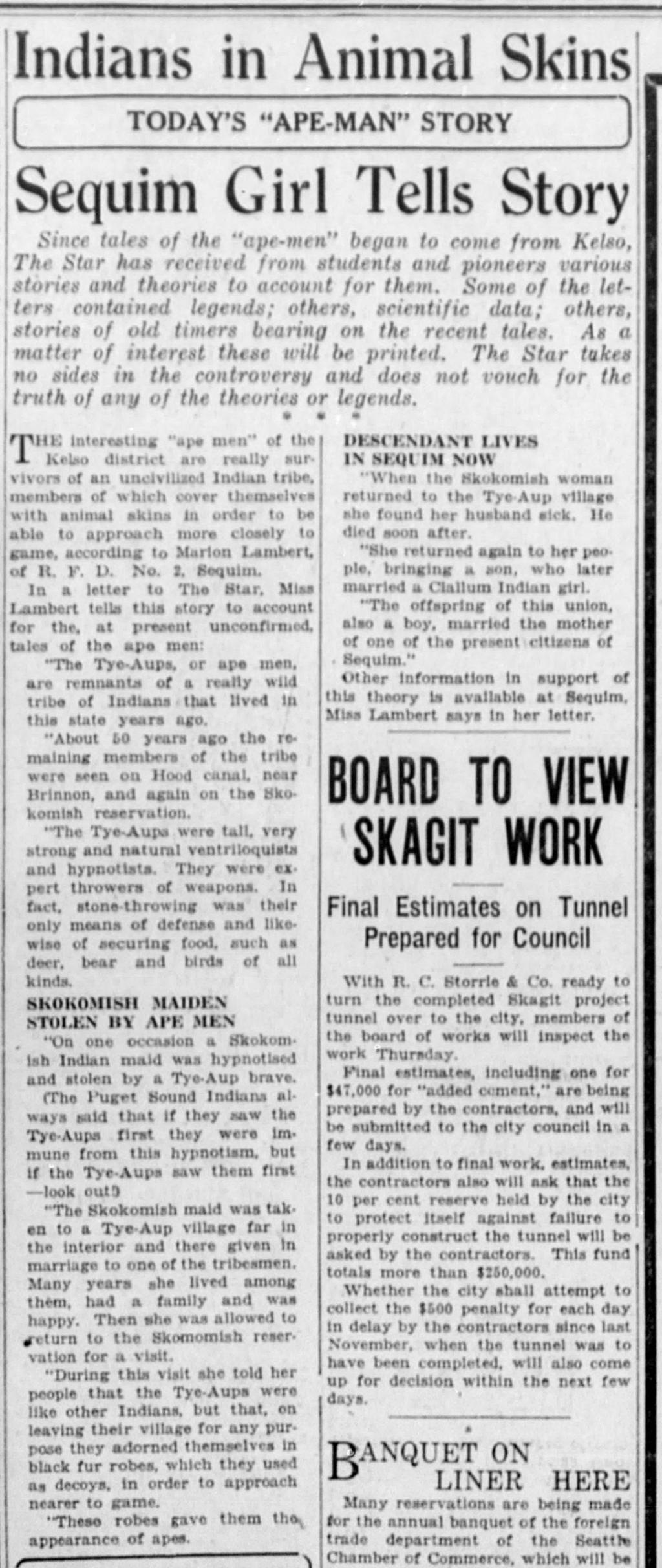
Indians in Animal Skins
Today’s “Ape-Man” Story
Sequim Girl Tells Story
Since tales of the “ape-men” began to come from Kelso, The Star has received from students and pioneers various stories and theories to account for them. Some of the letters contained legends; other, scientific data; others, stories of old timers bearing on the recent tales. As a matter of interest these will be printed. The Star takes no sides in the controversy and does not vouch for the truth of any of the theories or legends.
The interesting “ape men” of the Kelso district are really survivors of an uncivilized Indian[*] tribe, members of which cover themselves with animal skins in order to be able to approach more closely to game, according to Marion Lambert of R. F. D. No. 2 Sequim.
In a letter to The Star, Miss Lambert tells this story to account for the, at present unconfirmed, tales of the ape men:
“The Tye-Aups, or ape men, are remnants of a really wild tribe of Indians that lived in this state years ago.
“About 50 years ago the remaining members of the tribe were seen on Hood canal, near Brinnon, and again on the Skokomish reservation.
“The Tye-Aups were tall, very strong and natural ventriloquists and hypnotists. They were expert throwers of weapons. In fact, stone-throwing was their only means of defense and likewise of securing food, such as deer, bear and birds of all kinds.
Skokomish Maiden Stolen By Ape Men
“On one occasion a Skokomish Indian maid was hypnotised and stolen by a Tye-Aup brave. (The Puget Sound Indians always said that if they saw the Tye-Aups first they were immune from the hypnotism, but if the Tye-Aups saw them first – look out!)
“The Skokomish maid was taken to a Tye-Aup village far in the interior and there given in marriage to one of the tribesmen. Many years she lived among them, had a family and was happy. Then she was allowed to return to the Skokomish reservation for a visit.
“During this visit she told her people that the Tye-Aups were like other Indians, but that, on leaving their village for any purpose they adorned themselves in black fur robes, which they used as decoys, in order to approach nearer to game.
“These robes gave them the appearance of apes.
Descendant Lives In Sequim Now
“When the Skokomish woman returned to the Tye-Aup village she found her husband sick. He died soon after.
“She returned again to her people, bringing a son, who later married a Clallum Indian girl.
“The offspring of this union, also a boy, married the mother of one of the present citizens of Sequim.”
Other information in support of this theory is available at Seqium, Miss Lambert says in her letter.
Disclaimer: This 1924 newspaper article was published prior to 1931. Under United States copyright law (specifically the 95-year rule), this work has entered the public domain and is thus free to use or republish. It is presented here as an interesting and folkloric newspaper oddity.
[*] Note on offensive terminology: This article uses incorrect and offensive terminology to refer to indigenous or native people, which was unfortunately common at the time. For the purposes of historical documentation of the material, the article has been unaltered and is presented as it was previously published, retaining its original language and word usage. The derogatory term used in the article is a product of colonialism and should not be used to refer to indigenous people.
Source(s): https://www.loc.gov/resource/sn87093407/1924-07-29/ed-1/?sp=14
Categories: Newspapers, Proto-Bigfoot, Ape Canyon, Washington (WA)