
The Evening Times (Washington, D.C.), November 7th 1898
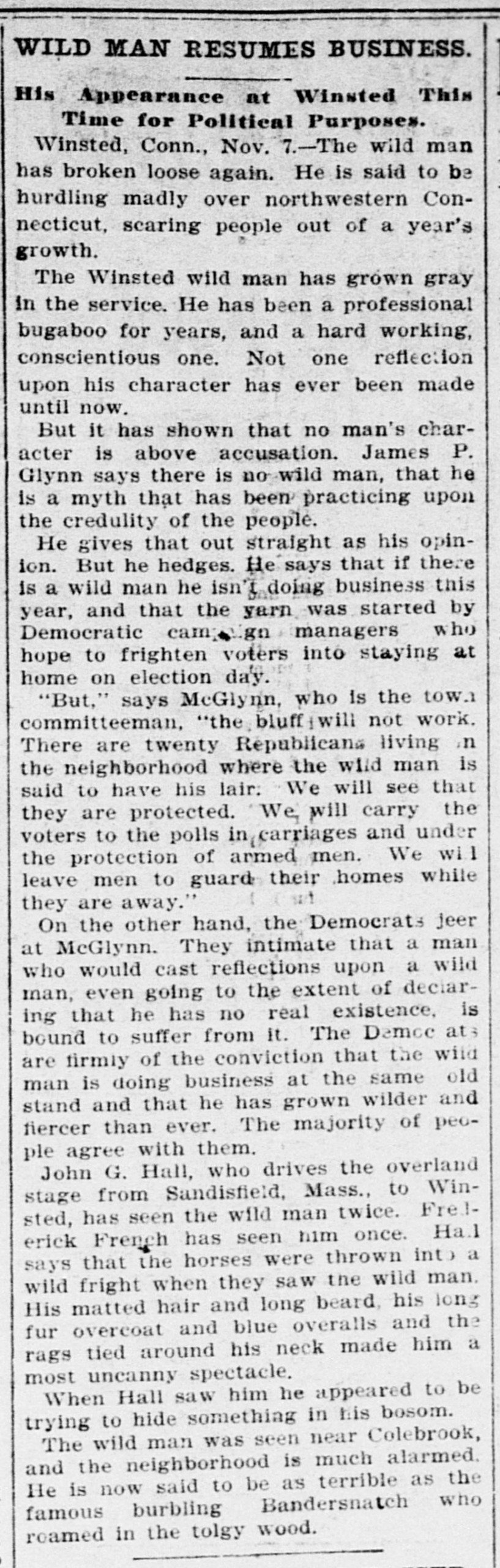
Wild Man Resumes Business
His Appearance at Winsted This Time for Political Purposes.
Winsted, Conn., Nov. 7. – The wild man has broken loose again. He is a said to be hurdling madly over northwestern Connecticut, scaring people out of a year’s growth.
The Winsted wild man has grown gray in the service. He has been a professional bugaboo for years, and a hard working, conscientious one. Not one reflection upon his character has ever been made until now.
But it has shown that no man’s character is above accusation. James P. Glynn says there is no wild man, that he is a myth that has been practicing upon the credulity of the people.
He gives that out out straight as his opinion. But he hedges. He says that if there is a wild man he isn’t doing business this year, and that the yarn was started by Democratic campaign managers who hope to frighten voters into stayed at home on election day.
“But,” says McGlynn, who is the town committeeman, “the bluff will not work. There are twenty Republicans living in the neighborhood where the wild man is said to have his lair. We will see that they are protected. We will carry the voters to the polls in carriages and under the protection of armed men. We will leave men to guard their homes while they are away.”
On the other hand, the Democrats jeer at McGlynn. They intimate that a man who would cast reflections upon a wild man, even going to the extent of declaring that he has no real existence, is bound to suffer from it. The Democrats are firmly of the conviction that they wild man is doing business at the same old stand and that he has grown wilder and fiercer than ever. The majority of people agree with them.
John G. Hall, who drives the overland stage from Sandisfield, Mass., to Winsted, has seen the wild man twice. Frederick French has seen him once. Hall says that the horses were thrown into a wild fright when they saw the wild man. His matted hair and long beard, his long fur overcoat and blue overalls and the rags tied around his neck made him a most uncanny spectacle.
When Hall saw him he appeared to be trying to hide something in his bosom. The wild man was seen near Colebrook, and the neighborhood is much alarmed. He is now said to be as terrible as the famous burbling Bandersnatch who roamed in the tolgy wood.
Disclaimer: This 1898 newspaper article was published prior to 1931. Under United States copyright law (specifically the 95-year rule), this work has entered the public domain and is thus free to use or republish. It is presented here as an interesting and folkloric newspaper oddity.
Context: “Wild Men” or “Wild People” were purportedly “feral” people who lived in the wilderness in European folklore, representing nature. They were often depicted as tall and hair-covered. In the 1800’s and early 1900’s, stories of encounters with people in or from the wilderness including hermits, houseless people, or people going through a mental health crisis, were often reported in American newpress and labeled “Wild Men” as a popular newspaper curiosity genre.
Source(s): https://www.loc.gov/resource/sn84024441/1898-11-07/ed-1/?sp=6
Categories: Newspapers, Wild People, Connecticut (CT)