
The Sedalia Weekly Bazoo (Sedalia, Mo.), July 24th 1883
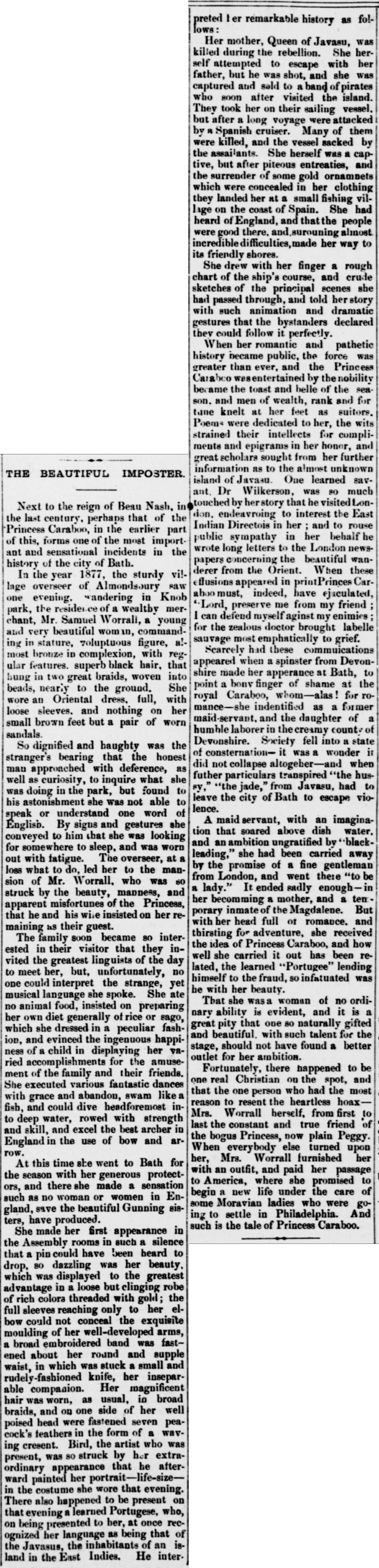
The Beautiful Imposter.
Next to the reign of Beau Nash, in the last century, perhaps that of the Princess Caraboo, in the earlier part of this, forms one of the most important and sensational incidents in the history of the city of Bath.
In the year 1877, the sturdy village overseer of Almondsbury saw one evening, wandering in Knob park, the residence of a wealthy merchant, Mr. Samuel Worrall, a young and very beautiful woman, commanding in stature, voluptuous figure, most bronze in complexion, with regular features. Superb black hair, that hung in two great braids, woven into beads, nearly to the ground. She wore an Oriental dress, full, with loose sleeves, and nothing on her small brown feet but a pair of worn sandals.
So dignified and haughty was the stranger’s bearing that the honest man approached with deference, as well as curiosity, to inquire what she was doing in the park, but found to his astonishment she was not able to speak or understand one word of English. By signs and gestures she conveyed to him that she was looking for somewhere to sleep, and was worn out with fatigue. The overseer, at a loss what to do, led her to the mansion of Mr. Worrall, who was so struck by the beauty, manness, and apparent misfortunes of the Princess, that he and his wife insisted on her remaining as their guest.
The family soon became so interested in their visitor that they invited the greatest linguists of the day to meet her, but, unfortunately, no one could interpret the strange, yet musical language she spoke. She ate no animal food, insisted on preparing her own diet generally of rice and sago, which she dressed in a peculiar fashion, and evinced the ingenuous happiness of a child in displaying her varied accomplishments for the amusement of the family and their friends. She executed various fantastic dances with grace and abandon, swam like a fish, and could dive headforemost into deep water, rowed with strength and skill, and excel the best archer in England in the use of bow and arrow.
At this time she went to Bath for the season with her generous protectors, and there she made a sensation such as no woman or women in England, save the beautiful Gunning sisters, have produced.
She made her first appearance in the Assembly rooms in such a silence that a pin could have been heard to drop, so dazzling was her beauty, which was displayed to the greatest advantage in a loose but clinging robe of rich color threaded with gold; the full sleeves reaching only to her elbow could not conceal the exquisite moulding of her well-developed arms, a broad embroidered band was fastened about her round and supple waist, in which was stuck a small and rudely-fashioned knife, her magnificent hair was worn, as usual, in broad braids, and no one side of her well poised head were fastened seven peacock’s feathers in the form of a waving crescent. Bird, the artist who was present, was so struck by her extraordinary appearance that he afterward painted her portrait – life-size – in the costume she wore that evening. There also happened to be present on that evening a learned Portuguese, who, on being presented to her, at once recognized her language as being that of the Javaus, the inhabitants of an island in the East Indies. He interpreted her remarkable history as follows:
Her mother, Queen of Javasu, was killed during a rebellion. She herself attempted to escape with her father, but he was shot, and she was captured and sold to a band of pirates who soon after visited the island. They took her on their sailing vessel, but after a long voyage were attacked by a Spanish cruiser. Many of them were killed, and the vessel sacked by the assailants. She herself was a captive, but after piteous entreaties, and the surrender of some gold ornaments which were concealed in her clothing, they landed her at a small fishing village on the coast of Spain. She had heard of England, and that the people were good there, and, surouning almost incredible difficulties, made her way to its friendly shores.
She drew with her finger a rough chart of the ship’s course, and crude sketches of the principal scenes she had passed through, and told her story with such animation and dramatic gestures that the bystanders declared they could follow it perfectly.
When her romantic and pathetic history became public, the force was greater than ever, and the Princess Caraboo was entertained by the nobility, became the toast and belle of the season, and men of wealth, rank and fortune, knelt at her feet as suitors. Poems were dedicated to her, the wits strained their intellects for compliments and epigrams in her honor, and great scholars sought from her further information as to the almost unknown island of Javasu. One learned savant, Dr Wilkerson, was so much touched by her story that he visited London, endeavoring to interest the East Indian Directors in her; and to rouse public sympathy in her behalf he wrote long letters to the London newspapers concerning the beautiful wanderer from the Orient. When these effusions appeared in print Princess Caraboo must, indeed, have ejaculated[1], “Lord, preserve me from my friend; I can defend myself against my enemies;” for the zealous doctor brought labelle sauvage most emphatically to grief.
Scarcely had these communications appeared when a spinster[*] from Devonshire made her appearance at Bath, to point a bony finger of shame at the royal Caraboo, whom – alas! for romance – she identified as a former maid-servant, and the daughter of a humble laborer in the cream county of Devonshire. Society fell into a state of consternation – it was a wonder it did not collapse altogether – and when further particulars transpired “the hussy,”[*] “the jade,” from Javasu, had to leave the city of Bath to escape violence.
A maid servant, with an imagination that soared above dish water, and an ambition ungratified by “black-leading,”[2] she had been carried away by the promise of a fine gentleman from London, and went there “to be a lady.” It ended sadly enough – in her becoming a mother, and a temporary inmate of the Magdalene. But with her head full or romance, and thirsting for adventure, she received the idea Princess Caraboo, and how well she carried it out has been related, the learned “Portuguese” lending himself to the fraud, so infatuated was he with her beauty.
That she was a woman of no ordinary ability is evident, and it is a great pity that one so naturally gifted and beautiful with such talent for the stage, should not have found a better outlet for her ambition.
Fortunately, there happened to be one real Christian on the spot, and that the one person who had the most reason to resent the heartless hoax – Mrs. Worral herself, from first to last the constant and true friend of the bogus Princess, now plain Peggy. When everybody else turned upon her, Mrs. Worral furnished her with an outfit, and paid her passage to America where she promised to begin a new life under the care of some Moravian ladies who were going to settle in Philadelphia. And such is the tale of Princess Caraboo.
Disclaimer: This 1883 newspaper article was published prior to 1931. Under United States copyright law (specifically the 95-year rule), this work has entered the public domain and is thus free to use or republish. It is presented here as an interesting and folkloric newspaper oddity.
[1] Definition: To exclaim or blurt out speech.
[2] Definition: The household cleaning process of coating and polishing cast-iron.
[*] Note on offensive terminology: This newspaper article uses derogatory and offensive terms to refer to women. (The article also seems preoccupied with discussing Princess Caraboo’s looks.) For the purposes of historical documentation of the material, this article has been unaltered and is presented as it was previously published, retaining its original language and word usage. The derogatory terms used in the article should not be used to refer to people.
Source(s): https://www.loc.gov/resource/sn90061066/1883-07-24/ed-1/?sp=2
Categories: Newspapers, Mysterious Strangers, Princess Caraboo, Hoaxes