
Ape Canyon – 1924 [WA]
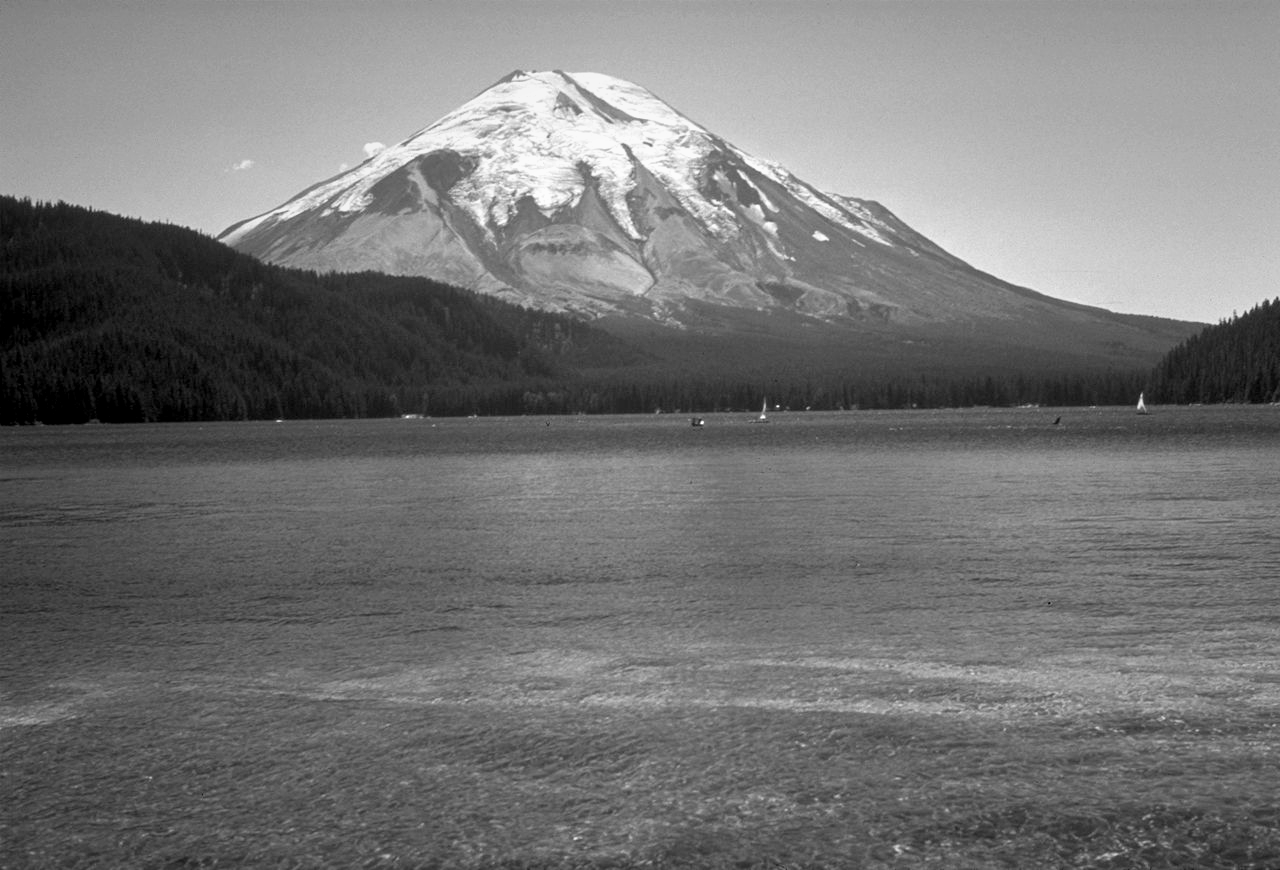
In July of 1924, a group of prospectors led by Marion Smith, including his son Roy Smith and son-in-law Fred Beck, were on an expedition looking for gold near Spirit Lake near Mount St. Helens in Washington. The prospectors reportedly claimed to have witnessed large hairy “Ape-Men” or “Mountain Devils.” Large footprints purportedly found by the prospectors measured about 14 inches.[1]
According to the Seattle Star newspaper in 1924, Fred Beck and Marion Smith had gone to the springs for water. Smith was walking ahead on the trail, and as they came to a precarious spot, Beck stood on the edge while Smith descended. As he stood on top of the slope Beck reportedly saw a huge black shape moving among the trees on the opposite side of the canyon roughly about 60 feet away. “Look, there is the thing,” Beck called to Smith.[2] Marion reportedly shot his rifle multiple times at the Mountain Devil which then dodged behind a tree and stared at the two men, only its huge head in sight. The beast then took off and ran out of view.
Fred Beck, referring to when he first saw the Mountain Devil, reportedly said in 1924: “The flat nosed face, was surrounded by an encircling halo of black hair, mixed with white and the ears were huge, cupped.”[2] Imperial Valley Press stated in 1924: “Marion Smith claimed to have fired two shots at one of the beasts” and also added that “Roy Smith declared that [on one occasion] he had been chased to the cabin from a nearby spring where he was drawing water.”[3]
One night the miner’s cabin was purportedly bombarded with showers of rocks that damaged their roof. Some rocks were reportedly thrown into their cabin.[4]
The next morning, the miners witnessed the Ape-Men again and Fred Beck shot at one which reportedly fell off a ridge and into a deep canyon below. According to the Alaska Daily Empire in 1924, the Ape-Men were “strange animals said to weigh about 400 pounds with hairy bodies and faces, claw-like fingers, black hair and long arms.”[1] The men were purportedly so frightened by the experience that they ended their expedition and left their mine behind. In a statement to the newspress, one of the miners reportedly stated: “We expected that people would disbelieve us; but we ran into the beast – whatever it was – four times, and finally packed up and left a perfectly good mine to get away from it.”[2]
The story was printed nationwide and became a sensation. Several groups then journeyed to the area to find, photograph, or kill the supposed Mountain Devils but could not find them. The U. S. Forest Service (rangers J. H. Huffman and W. M. Welsh[5][6]) searched but to no avail. Searchers did note that the rocks were still inside the cabin but that they could have been placed there by humans.[7] The place where the miners supposedly saw the Ape-Men then became known as “Ape Canyon.” It was not named that beforehand.
Knowledge soon spread that the members of the Smith-Beck prospecting expedition were dabblers in “Spiritualism” and had previously conducted “Séances.” Kelso locals reportedly began to speculate that the men “were emotionally wrought up by a séance they had mistaken an upright bear.”[3] Fred Beck in July of 1924 stated to newspress, “I have attended quite a few spiritualistic meetings,” but denied that the miners specifically did séances in their cabin before the sightings.[2]
Indigenous “Seeahtiks” Connection:
In July 1924, a man from the Clallam native tribe, and editor of a weekly indigenous publication, came forward to the newspress with an interesting connection. There is a discrepancy about the man’s name with some newspapers claiming it was Jorg Totsti[8] or George Totsgi[9][10] or George Totagi.[11]
The native man said that what the miners encountered could perhaps have been a lost or outcast tribe of natives, called the “Seeahtiks,” who were supposedly huge in stature, reportedly seven to eight feet tall, and hairy like bears.[12][13][14][15][16] This concept of tall hairy outcasts is of course the classic “Wild Man” archetype that would later be written about in British Columbia in 1929 by J. W. Burns who coined the angclizied term “Sasquatch” to describe such native Wild Man stories.
According to the New Britain herald[14] in 1924, Jorg or George reportedly stated that the Seeahtiks spoke “the Clallam language and are adept at imitating the sounds of birds.” He stated: “The Seeahtiks were last heard of by the Clallam [natives] about 15 years ago [1910] and it was believed by the present [natives] that they had become extinct.” He continued that “The Seeahtiks made their home in the heart of the wilderness on Vancouver Island and on the Olympic range.” He also reportedly said: “The Seeahtiks are seven to eight feet tall with hairy bodies, like bears. They are great hypnotists and also have a gift of ventriloquism, throwing their voices great distances.”[14][13][15][16][17]
The Ape-men or Mountain Devils, according to newspress about the Smith-Beck party at least, were not described as human “Wild Men,” but instead as strange ape creatures. An interesting note here as well is that later “Bigfoot” researchers would also state that “Bigfoot” imitated birds or threw their voices as well.
Sequim Story:
Another person, Miss Marion Lambert of Sequim, Washington, later came forward with a letter to the Seattle Star on July 29th 1924, stating: “The Tye-Aups, or ape men, are remnants of a really wild tribe of Indians that lived in this state years ago. […] About 50 years ago the remaining members of the tribe were seen on Hood canal, near Brinnon, and again on the Skokomish reservation. […] The Tye-Aups were tall, very strong and natural ventriloquists and hypnotists. They were expert throwers of weapons. In fact, stone-throwing was their only means of defense and likewise of securing food, such as deer, bear and birds of all kinds.”[18]
“On one occasion a Skokomish [native] maid was hypnotised and stolen by a Tye-Aup brave. […] The Skokomish maid was taken to a Tye-Aup village far in the interior and there given in marriage to one of the tribesmen. Many years she lived among them, had a family and was happy. Then she was allowed to return to the Skokomish reservation for a visit. […] During this visit she told her people that the Tye-Aups were like other [natives], but that, on leaving their village for any purpose they adorned themselves in black fur robes, which they used as decoys, in order to approach nearer to game. […] These robes gave them the appearance of apes. […] When the Skokomish woman returned to the Tye-Aup village she found her husband sick. He died soon after. […] She returned again to her people, bringing a son, who later married a Clallum Indian girl. […] The offspring of this union, also a boy, married the mother of one of the present citizens of Sequim.”[18]
The YMCA Hypothesis:
According to the Evening Star on July 22nd 1924, two boys at the Young Men’s Christian Associated (YMCA) camp at Spirit Lake, on the slopes of Mount St. Helens, came forward stating they believed they were the “apes” which prospectors reported hurled stones at their cabin recently. One of the boys, Maxwell Pierce, in a letter to his parents, said: “We stumbled onto a trail that led to the miners’ cabin. A couple of them greeted us with revolvers. They told us we were the first ones ever to find their cabin. But the next day they told the rangers of their ‘ape man’ story.”[19]
There is a hypothesis that camping boys from the YMCA were the ones who threw or rolled the rocks down onto their cabin from a nearby ridge. If this were true, it would mean that the supposed ape-men were not the ones who threw the rocks but it wouldn’t explain the miner’s daytime sightings of the tall hairy Mountain Devils before and after the rock throwing night. The young boys testimony that the prospectors greeted them “with revolvers” would also seem to indicate that the men were indeed on edge perhaps due to their strange sightings or experiences previous.
The “Bigfoot” Revival / Patterson Interview:
After 1924, the Ape Canyon story was occasionally brought up again by newspapers as a local oddity.
In 1958, California’s “Bigfoot” became a social phenomenon when footprints were reportedly found in Humboldt County by logger Jerry Crew and the name “Bigfoot” was coined. (Those footprints were later said to be hoax done by his boss Ray Wallace according to Wallace’s family in 2002 after his passing.) Fortean Ivan Sanderson published two hugely-influential articles in True Magazine, the first entitled “America’s Abominable Snowman” in December 1959 and the second “A New Look at America’s Mystery Giant” in March 1960. He later put about a book called “Abominable Snowman: Legend Come To Life” in 1961 covering the topic of hairy humanoid sightings around the world. In these three works, Ivan Sanderson did not mention the Ape Canyon event at all.
Ivan Sanderson’s True magazine articles inspired Roger Patterson to get involved with the Bigfoot phenomenon. In Chapter three of Roger Patterson’s 1966 book “Do Abominable Snowmen of America Really Exist?,” Patterson writes:
“I have lived in Yakima, Washington for 28 years and had never heard of the hairy apes of Mt. St. Helens, although it is only seventy miles from home as the crow flies. I had to go to California to find out about them. There Betty Allen had a number of newspaper clippings of the startling events and that had happened in and around the vicinity of that mountain, mainly since 1924. […] Betty had wanted more news from that area, so I promised when I returned home I’d go there and look further into the matter.”
Roger interviewed Fred Beck in Beck’s cabin at some point reportedly in 1966 before his book was published in July. Patterson’s book covered the Ape Canyon event in detail within that chapter and recounted the tale to the newly inspired “Bigfoot” audience of the 1960’s who likely hadn’t heard of it beforehand unless they’d found the old news-clippings from 1924. According to Roger Patterson’s 1966 interview with Fred Beck, the miners reportedly never saw the Ape-Men actually throwing the rocks in 1924, only seeing them before and the day afterwards. Another interesting detail from the interview was that the men had supposedly discovered the large footprints and heard odd sounds including whistling during their expedition before ever encountering the beasts.
The “I Fought The Ape-Men of Mount Saint Helens (1967)” Booklet / Conclusion:
A year later in 1967, Fred Beck put out a booklet co-authored by his son, Ronald Beck, entitled “I Fought The Ape-Men of Mount Saint Helens (1967).” Ronald Beck may have given more of his own theories and highlighted Spiritualists aspects more, but as evident by newspapers, Fred Beck himself was provably into Spiritualism not only in 1960s but also before in the 1920s. Fred had passed along his fascination with Spiritualism to his son Ronald Beck.
Marion Smith is referred to in the booklet by the pseudonym “Hank,” purportedly to avoid embarrassment to his relatives at the time.
The booklet talks of the prospectors in 1924 also encountering a giant Native American spirit guide, Fred meeting a mysterious and potentially-spirit woman who no one else met, the appearance of glowing white arrows that only some of the men could see which pointed towards where they should mine, and it makes the case that the Ape Men were spiritual beings that were not of this world and could seemingly phase in and out of reality. It also says that Fred Beck was purportedly a “clairvoyant” since his youth. This information is very interesting, but the giant Native American spirit guide, mystery woman, and white arrows seemingly weren’t printed about until the 1967 booklet.
In the late 1800s and early 1900s Spiritualism, psychic mediums, and Séance practices were very popular in America. Spiritualist practices did often include talk of Native American spirit guides as a narrative element. The white arrow stuff sounds like a form of divination when looking for gold, another classic or old-fashioned thing that some prospectors were no doubt into at the time. Kind of like how old-timers used dowsing rods when looking for things. It’s very plausible that those elements could have been of the time period of the 1920s but they were never noted before. That being said, as the booklet was written 43 years after the 1924 event, and is co-written by a secondary author, Ronald Beck, it is not a good primary source for the Ape Canyon incident.
Another influence that is very clear in the text of the booklet relating to its explanation of the Ape-Men is that of Theosophy, an off-shoot of Spiritualism, founded by Helena Blavatsky, that eventually birthed the New Age movement. This influence is made apparent by the brief mention of “Masters” (like the supposed enlightened “Masters of Wisdom” or “Mahatmas” concept from Blavatsky), as well as the way that the notions of “vibrations” and “manifestation” are used in the booklet. Theosophy claims that the universe is essentially a manifestation of energy vibrating at difference frequencies and that the goal of any human consciousness is to achieve a higher attunement of sorts and therefore a sense of enlightenment.
“I Fought The Ape-Men of Mount Saint Helens (1967),” inspired by this worldview, states: “In the true sense everything in the material world is a manifestation. Ever since the time the first essence of consciousness formed from the Great Void we cannot describe, different planes or dimensions of being were created or manifested. Occasionally we of this dimension of space can be conscious of other beings of a different vibration and consciousness. The Abominable Snowmen are from a lower plane. When the condition and vibration is at a certain frequency, they can easily, for a time, appear in a very solid body. […] The Snowmen are a missing link in consciousness, neither animal nor human. […] When this age or cycle of life that we are in moves on eventually to a higher cycle, and all life moves forward, these beings may stay and move up in consciousness in some other world in the far distant future.” It goes on to say: “Manifestation is made possible by vibration of power and certain fine substances. Beings manifested can be seen, heard, and take a definite form – sometimes less tangible but also, under other conditions, take a very tangible form.”
As it has been noted, these sections of the booklet seem to be written in a very different style than the speaking style of Fred Beck in the 1966 Roger Patterson interview.
The booklet correctly predicts that “no one will ever capture one, and no one will ever kill one […] or find a dead body of one to be examined by science.” It claims Fred Beck was “always conscious that we were dealing with supernatural beings, and I know the other members of the party felt the same.” At one point it’s mentioned that Fred Beck, looking for a pencil during the expedition in 1924, suddenly had one from his wife at home, with chew marks from his young son, appear inexplicably in his hand. This is offered as an example of “psychic phenomena” which should be taken more seriously and it’s stated that “if there is a phenomenon, there is also a world from which its qualities are manifested.” The booklet declares that Mountain Devils have a “psychic nature” and that looking for the beasts “should in time lead [people] to the gates of psychicism.” The book expresses doubts that the Ape-Men “will be seen by tens of thousands of people like flying saucers” which would be an incorrect statement if the decades of reported Bigfoot sightings that followed are taken at face value. Again, the booklet says: “The manifestation takes place as a result of an energized substance surrounding these beings. To what degree the average person sighting them has a part in this, I am not prepared to say. But I do know that some persons who are psychic have a degree of involvement in a sighting and help trigger the phenomenon.”
The 1967 booklet also directly references Roger Patterson and his “Abominable Snowmen of America Club,” though not by name, in chapter one, stating: “another man has written a book on the subject and has formed a club whose purpose is to find evidence to prove what they already believe: that abominable snowmen of America do exist.” The booklet uses the phrase “Abominable Snowmen” to refer to even the American sightings as well, in same way that Ivan Sanderson and then Roger Patterson did at the time. It would be fair to say the Roger Patterson was a big part of the Mountain Devil story’s revival in the late 1960s.
The Ape Canyon tale then became prominent again and became often repeated by Bigfoot researchers and authors, though its Spiritualist connections were often ignored, downplayed, or overlooked. John Green also covered the story in his first book “On the Track of the Sasquatch” in 1968. It was used as an example to bolster the Bigfoot craze throughout the late 1960s and beyond. From there, it became a main-stay and important part of the Bigfoot/Sasquatch legacy.
NEWSPAPER CLIPPINGS BELOW:
-
[1924] [7/15]: “Armed Party Going After Giant Gorillas In Washington State” [WA]
The Alaska Daily Empire (Juneau, Alaska), July 15th 1924 Armed Party Going After Giant Gorillas In Washington State KELSO, Wash., July 15. – Armed for big game and carrying a photographic equipment, a party of five prospectors have left here in search of the “mountain devils.” An Indian[*] legend 60 years ago in Cowlitz County,… Read More
-
[1924] [7/15]: “Gorilla Search Will Probably Be Fruitless” [WA]
Imperial Valley Press (El Centro, Calif.), July 15th 1924 Gorilla Search Will Probably Be Fruitless KELSO, Wash., July 15. – Although a party of four men under C. A. Parker, of the forestry service, left early Monday to hunt down and either kill or photograph the gorillas or “mountain devils” of Spirit Lake, the belief… Read More
-
[1924] [7/15]: Gorillas or Something Perturb Kelso Hunters [WA]
The Seattle Star (Seattle, Wash.), July 15th 1924 Gorillas or Something Perturb Kelso Hunters Kelso, Wash., July 15. – “We expected that people would disbelieve us; but we ran into the beast – whatever it was – four times, and finally packed up and left a perfectly good mine to get away from it.” This… Read More
-
[1924] [7/16]: “Gorilla Tribe In Washington Strange Thing” [WA]
The Alaska daily empire (Juneau, Alaska), July 16th 1924 Gorilla Tribe In Washington Strange Thing KELSO, Wash., July 16. – Jorg Totsti, Clallam tribe of Indians[*] and editor of the Indian weekly, said the gorilla like men reported by prospectors at Mount St. Helens and who are now being searched for by a party, are… Read More
-
[1924] [7/16]: “Hunters After Devil Beasts” [WA]
The Seattle star (Seattle, Wash.), July 16th 1924 Hunters After Devil Beasts Story Told by Prospectors Declared Partly Confirmed KELSO, July 16. – Altho[ugh] no report has been received from the expeditionary forces which Monday went into the hills to hunt the “mountain devil,” individuals who returned today from trips to the cabin of the… Read More
-
[1924] [7/16]: “More Parties Are On Hunt For Apes” [WA]
Imperial Valley press (El Centro, Calif.), July 16th 1924 More Parties Are On Hunt For Apes By United Press Leased Wire KELSO, Wash., July 16. – Although no report has been received from the expeditionary force which Monday went into the hills to hunt “Mountain Devils,” individuals who returned today from trips to the cabin… Read More
-
[1924] [7/17]: “Tribe of ‘Ape Indians’ Reported Found In Pacific Northwest” [WA]
The Bismarck Tribune (Bismarck, N.D.), July 17th 1924 Tribe of “Ape Indians” Reported Found In Pacific Northwest Several Parties Leave in Search of Verification of Existence of Tribe in Wilderness Who Attacked Band of Prospectors Kelso, Washington, July 17 (By the A. P.) – While awaiting reports from parties who have gone to the vicinity… Read More
-
[1924] [7/17]: “Tribe of Ape-Men, 7 to 8 Ft. Tall, Reported By Washington Trappers” [WA]
New Britain herald (New Britain, Conn.), July 17th 1924 Tribe of Ape-Men, 7 to 8 Ft. Tall, Reported By Washington Trappers Hairy [-] said to [-] with [-] Cabin Near Mount St. Helen’s – Searchers Start today. Kelso, Wash., July 17. – While awaiting reports from parties who have gone to the vicinity of Spirit… Read More
-
[1924] [7/18]: “‘Gorilla Men’ Branded Myth” [WA]
Casper Daily Tribune (Casper, Wyo.), July 18th 1924 “Gorilla Men” Branded Myth KELSO, Wash., July 18 – The story of “tall gorilla men,” or as some called them the “ape men” who were credited with having attacked a party of trappers in the mountains here last week, is a myth, two forest rangers declared here.… Read More
-
[1924] [7/18]: “‘Mountain Devils’ Prove Myth Says Party” [WA]
Imperial Valley Press (El Centro, Calif.), July 18th 1924 “Mountain Devils” Prove Myth Says Party By United Press Leased Wire KELSO, Wash., July 18. – C. Parker, former United States forest ranger, Frank Hein and R. S. Bailey, who composed the party which left here last Monday to hunt down the “Mountain Devils” in the… Read More
-
[1924] [7/19]: “Tribe of Devil Men or Ape Men Bombarded Cabin of Miners” [WA]
The Omaha morning bee (Omaha [Neb.]), July 19th 1924 Far off, near Spirit Lake, on Mount St. Helen’s, a party well armed, is hunting a “tribe of devil men, or ape men,” that have bombarded the cabins of miners. Indians[*] say they know the tribe of old. They are called Seeantiks[**], but were supposed to… Read More
-
[1924] [7/20]: “‘Ape Men’ Attack, Called Myth” [WA]
Brownsville Herald (Brownsville, Tex.), July 20th 1924 “Ape Men” Attack, Called Myth (By The Associated Press.) KELSO, Wash., July 19 – The tale of “tall gorilla men,” or as some called them, the “ape men” who were credited [with having attacked a party of trap]pers in the mountains here last week, […] is a myth,… Read More
-
[1924] [7/22]: “‘Ape Men’ Prove Youngster From Summer ‘Y’ Camp” [WA]
Evening Star (Washington, D.C.), July 22th 1924 “Ape Men” Prove Youngster From Summer “Y” Camp By the Associated Press. PORTLAND, Oreg., July 22, – Two boys at the Young Men’s Christian Associated camp at Spirit Lake, on the slopes of Mount St. Helens, believe they were the “apes” which prospectors reported hurled stones at their… Read More
-
[1924] [7/22]: “Camper Sought” [WA]
The Seattle Star (Seattle, Wash.), July 22nd 1924 Camper Sought “Ape Man” Story Revived by Deserted Outfit KELSO, Wash., July 22. – A report to the sheriff’s office here that a camp near St. Helens, on the upper Toulle river has been deserted for two weeks has aroused the fear that some camper has become… Read More
-
[1924] [7/29]: “Sequim Girl Tells Story” [WA]
The Seattle Star (Seattle, Wash.), July 29th 1924 Indians in Animal Skins Today’s “Ape-Man” Story Sequim Girl Tells Story Since tales of the “ape-men” began to come from Kelso, The Star has received from students and pioneers various stories and theories to account for them. Some of the letters contained legends; other, scientific data; others,… Read More
-
[1924] [7/31]: “Race of ‘Ape Men’ Said to Haunt Wilds of Mt. St. Helen’s In Southern Washington” [WA]
The Kevin Review (Kevin, Mont.), July 31st 1924 Race of “Ape Men” Said to Haunt Wilds of Mt. St. Helen’s In Southern Washington The fabled “mountain devils” or mountain gorillas of which the Indians[*] in the regions of the Cascade mountains have for the past sixty years been telling weird tales have at last been… Read More
–